
SEO
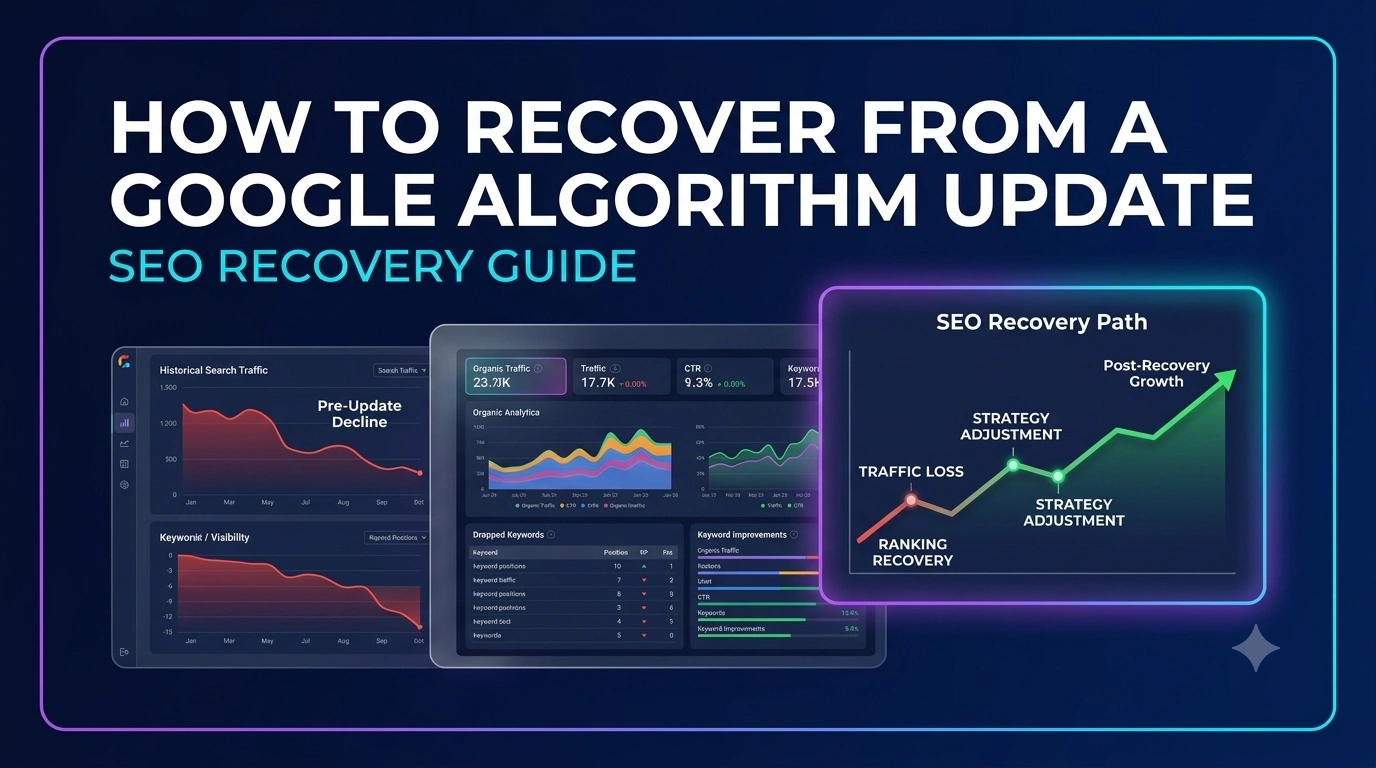
How to Recover From a Google Algorithm Update: SEO Recovery Guide
Google is explicit that core updates aren't penalties targeting specific sites. That distinction changes how recovery should actually be approached.
The short answer
Recovering from a Google algorithm update starts with correctly diagnosing what actually happened, because the fix is completely different depending on the cause. Per Google’s own documentation on core updates, broad core updates aren’t penalties targeting individual sites — they’re systemic re-evaluations of how content is ranked overall, meaning a drop reflects your content being reassessed against a changing bar, not a punishment for a specific violation.
Step 1: Confirm it was actually a core update
Before assuming an algorithm update caused a traffic drop, rule out simpler explanations: a broken deployment, an accidental noindex tag, a server outage, or seasonal demand changes. Check whether the timing of your drop actually aligns with a confirmed Google update, rather than assuming correlation where there may be a more mundane, more fixable cause.
Step 2: Use Google’s own self-assessment questions honestly
Google publishes a specific set of self-assessment questions on its Creating Helpful, Reliable, People-First Content guide, designed for exactly this situation. They center on a consistent theme: does this content genuinely help the person reading it, does it reflect real expertise or firsthand experience, and would someone be satisfied after reading it — or does it just restate what’s already available elsewhere without adding anything.
Answering these honestly, rather than defensively, is the actual diagnostic step most sites skip.
Step 3: Identify what changed relative to the update
- Did the update target a specific content type (reviews, news, a particular vertical) that overlaps with your content?
- Has your content’s actual usefulness kept pace with what’s now ranking above you — is it more thorough, more current, or more genuinely useful than yours?
- Is there a pattern across affected pages — thin content, outdated information, lack of firsthand expertise — that a broad update would plausibly have caught?
Step 4: Make deliberate improvements, not reactive ones
Rewriting everything in a panic, deleting large amounts of content, or making sweeping technical changes without a clear diagnosis often wastes effort or creates new problems. Instead, prioritize genuinely improving the specific content most likely affected — adding real depth, firsthand expertise, and clarity — rather than chasing every possible tactic at once.
Step 5: Set realistic recovery expectations
Recovery isn’t usually immediate, even after genuine improvements are made, because Google’s systems need to re-crawl and re-evaluate content at scale, and meaningful recovery often aligns more closely with the next broad update cycle than with any single day. This mirrors the same patience required in understanding how long SEO takes to show results more broadly.
A diagnostic checklist
| Check | What it tells you |
|---|---|
| Timing vs. confirmed update | Whether this is likely update-related at all |
| Technical health (crawl errors, indexing) | Whether a separate technical issue is the real cause |
| Content depth vs. competitors now ranking above you | Whether content quality is the likely factor |
| Pattern across affected pages | Whether it’s isolated or systemic across the site |
A broader SEO audit covering both technical and content factors is a reasonable next step if the cause isn’t immediately clear from the checks above, and Core Web Vitals are worth ruling out as a contributing factor too, since page experience issues can compound a content-related drop.
Common mistakes after a ranking drop
- Assuming every traffic drop is an algorithm update, without checking for simpler technical explanations first.
- Making sweeping, reactive changes without a clear diagnosis of what actually happened.
- Expecting immediate recovery after making improvements, rather than understanding recovery often aligns with future update cycles.
- Focusing only on technical fixes when the actual issue is content quality, or vice versa.
The bottom line
A Google algorithm update recovery process starts with an honest, evidence-based diagnosis — not a reactive scramble. Confirm the update actually correlates with your drop, use Google’s own self-assessment questions to evaluate content quality honestly, make deliberate rather than panicked improvements, and set realistic expectations that recovery often takes time and aligns with future update cycles rather than happening overnight.
Frequently asked questions
Is a traffic drop after a Google update a penalty?
No, and Google is explicit about this distinction. Core updates aren't penalties targeting individual sites — they're broad re-evaluations of how content is ranked overall. A drop means your content was reassessed relative to a changing bar, not that your site was singled out for punishment.
How long does recovery from a core update take?
There's no fixed timeline, but meaningful recovery often aligns with the next broad core update rather than happening immediately after changes are made, since Google's systems need to re-crawl and re-evaluate content at scale.
Should I make major changes immediately after a traffic drop?
Not before diagnosing what actually happened. Confirm a core update coincided with the drop, review Google's self-assessment questions against your content honestly, and make deliberate, well-reasoned improvements — reactive, panic-driven changes without a clear diagnosis often waste effort or make things worse.
Can technical SEO issues cause a drop that looks like an algorithm update?
Yes — it's worth ruling out a coincidental technical issue (a broken deployment, accidental noindex, server errors) before assuming a core update is the cause, since the timing can overlap and the actual fix is completely different.
Will disavowing links or deleting content help recovery?
Not for a typical core update, which is about content quality and helpfulness rather than link-based spam signals. Those actions are more relevant to manual actions or link-spam-specific issues, and applying them to a core-update-related drop usually addresses the wrong problem.
More insights
SEO
Why Is My Website Not Ranking on Google? 15 Common SEO Problems
"We're not ranking" is rarely one problem. It's usually one of about fifteen specific, diagnosable issues — and most of them are easier to identify than business owners expect.
Read Article
SEO
SEO Audit Checklist for Businesses: 25 Things to Check Before Hiring an Agency
Most businesses hire an SEO agency without knowing what's actually broken. A basic audit before that conversation changes the entire negotiation — here's exactly what to check.
Read Article
SEO
Core Web Vitals and SEO: How Website Speed Affects Google Rankings
Core Web Vitals aren't an abstract technical score — they're Google's attempt to measure whether your site actually feels fast and stable to a real visitor.
Read Article