
Content Marketing
SEO Content Strategy: How to Build a Topic Cluster That Ranks
A pile of disconnected blog posts and a genuine topic cluster can cover the exact same subjects — and perform completely differently in search.
The short answer
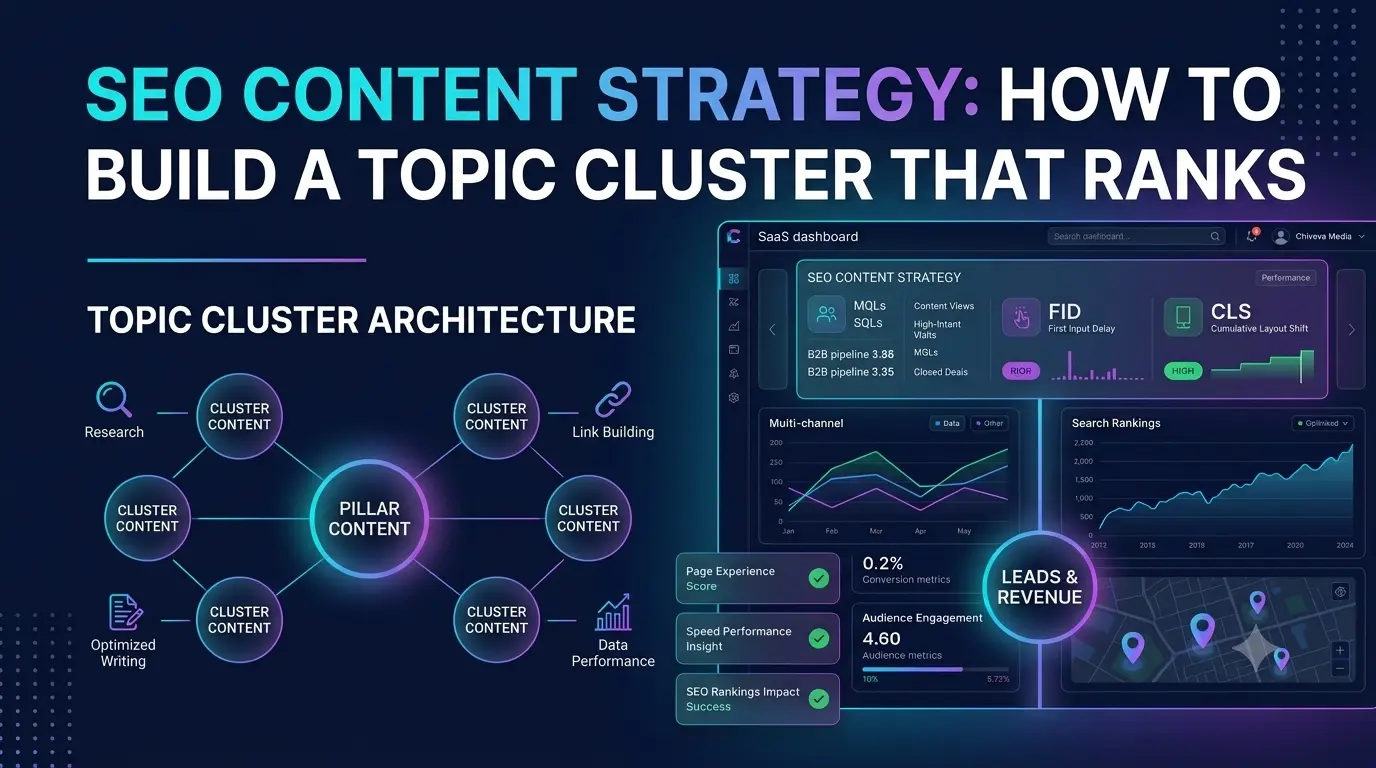
A topic cluster is a structured group of content built around one broad subject: a comprehensive “pillar” page covering the topic at a high level, surrounded by multiple in-depth “cluster” articles that each address a specific subtopic, all connected through deliberate internal linking. This structure signals genuine topical depth to search engines far more effectively than the same subjects covered as disconnected, unlinked blog posts — and it creates a clearer, more navigable path for readers researching a topic in depth.
Why disconnected content underperforms
A business can publish plenty of genuinely good individual articles and still struggle to build authority on a topic if those articles never reference or reinforce each other. Search engines rely partly on internal linking patterns to understand how content relates and how deeply a site covers a given subject — a pile of isolated posts, even good ones, doesn’t communicate that depth nearly as clearly as a deliberately interlinked cluster does.
The core structure
- The pillar page covers the broad topic comprehensively, at a level detailed enough to be genuinely useful, but not so deep on any single subtopic that it duplicates what a dedicated cluster article would cover.
- Cluster articles each go deep on one specific subtopic, answering that narrower question thoroughly — this is where most of a cluster’s actual search traffic tends to land, since specific, long-tail queries are often easier to rank for than the broad pillar topic itself.
- Internal links connect the pillar to every cluster article, and each cluster article back to the pillar, plus links between closely related cluster articles where genuinely relevant — not forced.
How to build one from scratch
- Choose a topic broad enough to support multiple genuine subtopics, but specific enough to stay coherent — broad enough for real depth, narrow enough to stay focused.
- Identify the real subtopics, grounded in actual keyword research and real questions your audience has, not an arbitrary list generated to hit a content quota.
- Build or designate the pillar page to comprehensively introduce the topic and link out to each subtopic.
- Write each cluster article to genuinely stand on its own, thoroughly answering its specific question, while also linking back to the pillar and to closely related cluster pieces.
- Keep the cluster connected and current — adding new cluster articles over time as new subtopics emerge, and revisiting older ones as the topic evolves.
Turning existing content into a cluster
Most businesses don’t need to start from zero. Reviewing your existing content for a natural pillar topic — and adding genuine internal links connecting related existing posts to it — is often faster and more valuable than writing entirely new content, and it’s a reasonable first step before investing in new SEO content built to generate leads.
Why this structure matters more, not less, in AI-driven search
As search increasingly involves AI systems retrieving and synthesizing answers rather than presenting a simple list of links, clear topical structure and strong internal linking help these systems understand the relationships between your content — a factor that supports both traditional rankings and the kind of retrievability covered in our guide to what GEO actually is. Well-structured clusters are, in effect, doing the organizational work that both traditional search engines and newer AI systems benefit from.
A note on scale
For topics with a genuinely large number of near-identical subtopic variations (locations, product combinations), programmatic SEO can be a more efficient execution method than manually writing individual cluster articles — but the underlying logic is the same: real structure, real depth, and real connections between related content, whether built manually or generated at scale.
Common mistakes
- Publishing cluster-style content with no actual internal linking, missing the structural benefit entirely.
- Forcing links between unrelated content just to simulate a cluster structure, which reads as unnatural to both readers and search engines.
- Building a pillar page too thin to be genuinely useful on its own, functioning only as a link directory rather than real content.
- Choosing a topic too narrow to support genuine subtopic depth, resulting in thin, redundant cluster articles.
The bottom line
A topic cluster strategy turns individually good content into a structurally reinforced group that communicates real topical depth to both search engines and readers. The mechanics are straightforward — a comprehensive pillar, genuinely deep cluster articles, and deliberate internal linking between them — but the payoff compounds over time as clusters mature, making this one of the more durable content investments a business can make.
Frequently asked questions
What's the difference between a pillar page and a cluster article?
A pillar page covers a broad topic comprehensively at a higher level, while cluster articles each go deep on a specific subtopic related to that pillar. The pillar links out to each cluster article, and each cluster article links back to the pillar, creating a structured, mutually reinforcing group rather than disconnected individual posts.
How many articles does a topic cluster need?
There's no fixed number — it depends on how many genuinely distinct, valuable subtopics exist within the broader topic. A cluster built around real subtopics that each deserve their own page will naturally settle on the right count, rather than hitting an arbitrary target.
Does topic cluster strategy still work with AI-driven search?
If anything, it helps more. Clear topical structure and strong internal linking make it easier for both traditional search engines and AI systems to understand how your content relates and establish topical depth — a factor that supports both ranking and retrievability in generative search.
Can I turn existing, disconnected blog posts into a topic cluster?
Yes — this is a common and often high-value exercise. Identify a broad topic your existing posts already touch on, either write or designate a pillar page, and add genuine internal links connecting the related posts to it and to each other, rather than starting from scratch.
Should every topic on my site be built as a cluster?
Only topics with genuine depth and multiple distinct subtopics worth covering separately benefit from the cluster structure. A narrow topic with only one or two real angles doesn't need to be artificially split into multiple thin articles just to form a cluster.
More insights

SEO
How to Do Keyword Research for a Business Website: Complete 2026 Guide
The keyword with the most search volume is rarely the one worth targeting first. Here's a practical, non-inflated approach to keyword research for a real business.
Read Article
Content Marketing
How to Create SEO Content That Actually Generates Leads
A lot of SEO content ranks well and generates almost no business value. Here's the difference between content built to rank and content built to rank and convert.
Read Article
AI Search & GEO
What Is GEO? How to Optimize Your Brand for AI Search in 2026
GEO has a real academic origin and a real mechanism behind it — it's not just SEO with a new name. Here's what it actually is, and what Google itself says about optimizing for it.
Read Article