
Content Marketing
How to Create SEO Content That Actually Generates Leads
A lot of SEO content ranks well and generates almost no business value. Here's the difference between content built to rank and content built to rank and convert.
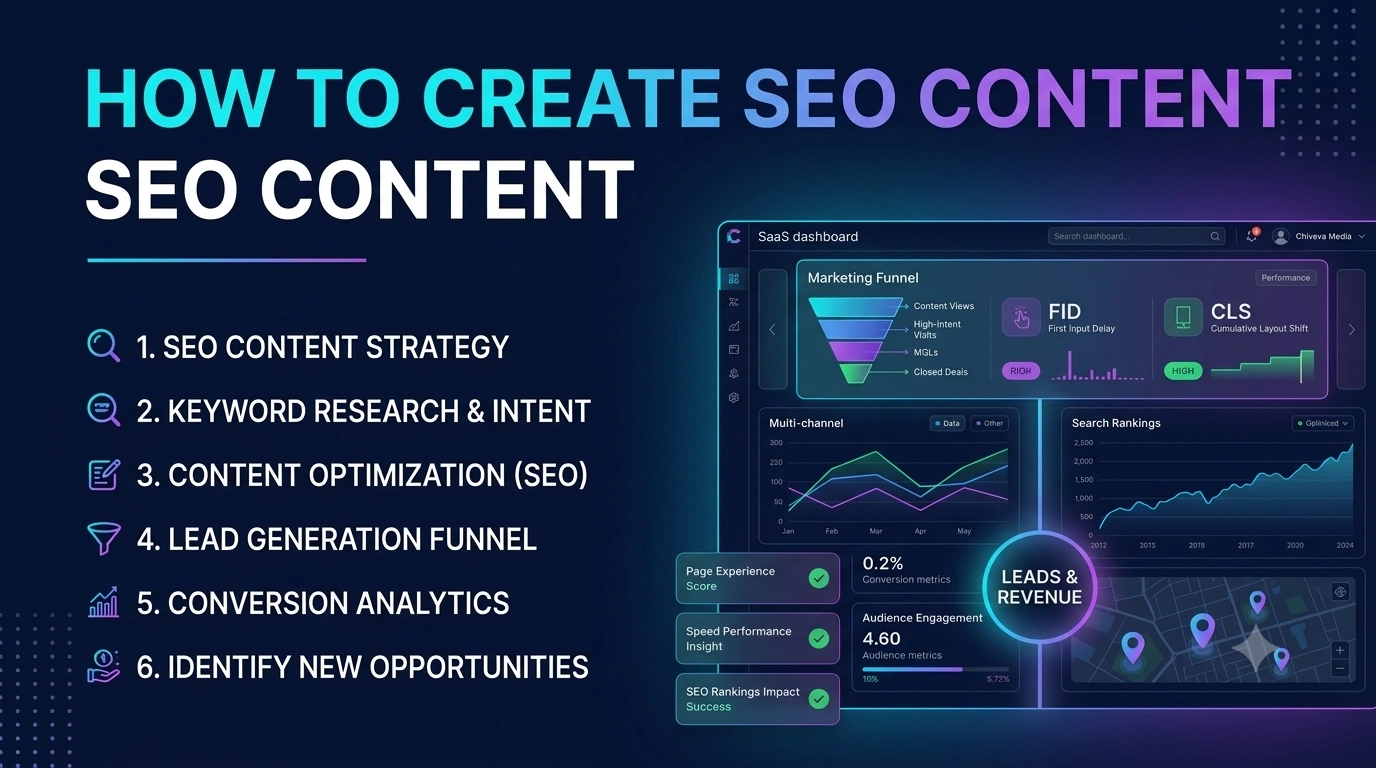
The short answer
SEO content that generates leads is built with two goals from the start, not one added on after the fact: it needs to genuinely satisfy what someone searched for, and it needs a clear, relevant next step once that need is met. Content built purely to rank — optimized for keywords and length with no real conversion path — often succeeds at the first goal and completely misses the second, which is why so much “successful” SEO content produces traffic without producing leads.
Why ranking and converting are separate problems
Search engines reward content that satisfies search intent — clear, thorough, genuinely useful answers to what someone searched. None of that inherently includes giving the reader a reason to take a next step with your business. A well-optimized, well-ranking article can fully answer someone’s question and then simply end, leaving no path from “I got my answer” to “I should talk to this business.” Building for both requires treating conversion as a design decision, not an afterthought bolted onto finished content.
What makes SEO content actually convert
- Match the call to action to the content’s actual intent. A purely informational article (“what is X”) shouldn’t force a hard sales pitch, but it can offer a genuinely relevant next resource. A more commercial-intent article (“best X for Y”) can support a more direct ask, because the reader is closer to a decision already.
- Place the conversion opportunity where attention actually is, not just at the very bottom after a reader may have already left. A relevant mid-content prompt, alongside a clear closing call to action, gives more genuine opportunities to convert without feeling forced.
- Make the next step obviously valuable, not just present. “Contact us” is a weaker ask than a specific, relevant offer tied to the exact problem the content just addressed.
- Keep the content genuinely thorough, not padded. Content that fully answers the question builds enough trust and goodwill that a relevant call to action feels earned rather than intrusive.
- Support content-market fit, not just keyword-search fit. Ranking for a keyword that doesn’t actually align with what your business offers produces traffic that was never going to convert, regardless of how good the content or call to action is.
A useful test for existing content
For any published article, ask: if someone read this and got exactly what they came for, is there an obvious, relevant next step available to them — or does the article just stop? Content that “just stops” is a strong candidate for adding a genuinely relevant call to action rather than a generic one.
How this fits into a broader content strategy
Individual pieces of lead-generating content work best as part of a broader topic cluster strategy, where related content reinforces topical authority and creates multiple genuine paths toward conversion across a connected set of pages, rather than relying on any single article to do all the work. It also depends on starting from keyword research that reflects real business-relevant intent, not just search volume — content that ranks for the wrong intent won’t convert no matter how well the call to action is designed.
Why this matters even more for AI-driven search
As more search happens through AI-generated answers rather than a list of links, content that’s genuinely thorough and directly useful — the same qualities that support conversion — also tends to perform better in AI search retrieval, a dynamic covered in more depth in what GEO actually is.
Common mistakes
- Treating the call to action as an afterthought, added identically to every article regardless of its actual intent.
- Optimizing purely for keywords and length, producing content that ranks but doesn’t genuinely serve the reader.
- Using one generic CTA everywhere, rather than matching the ask to where the reader actually is in their decision process.
- Ranking for keywords with no real business relevance, generating traffic that was never a realistic lead source.
The bottom line
SEO content generates real leads when it’s built to do two things at once: genuinely satisfy what someone searched for, and offer a clear, relevant next step once that need is met. This isn’t in tension with ranking well — search engines reward thorough, genuinely useful content, and a well-matched call to action doesn’t undermine that. The content that underperforms is the content built for only one of those two goals, usually the ranking half, with conversion never designed in from the start.
Frequently asked questions
Why does my content rank well but not generate any leads?
Usually because it was built to satisfy search intent alone, without a clear next step for the reader once that intent is met. Ranking gets attention; conversion requires a deliberate path from 'question answered' to 'here's what to do next,' which many high-ranking articles simply don't include.
Should every blog post have a call to action?
Every post should have a relevant next step, but it doesn't have to be a hard sales pitch. A purely informational article can offer a related resource or a soft next step, while a more commercial-intent article can support a more direct call to action — the key is matching the ask to where the reader actually is.
How long should lead-generating SEO content be?
As long as it needs to be to genuinely answer the question well — length isn't the goal, thoroughness is. Padding content to hit a word count usually hurts both rankings and conversion, since it makes the actual answer harder to find.
Do I need gated content (behind a form) to generate leads from SEO?
Not necessarily, and gating can sometimes hurt SEO since search engines can't fully evaluate content they can't access. Many effective lead-generation strategies use ungated content that ranks and converts through a clear in-content call to action, reserving gated offers for genuinely higher-value resources.
What's the biggest mistake in SEO content meant to generate leads?
Writing purely for the algorithm — keyword density, arbitrary length targets — without genuinely serving the reader's actual need or giving them a clear reason to take a next step. Content built primarily to rank, with conversion as an afterthought, usually underperforms content built to be genuinely useful with a deliberate conversion path built in from the start.
More insights

Content Marketing
SEO Content Strategy: How to Build a Topic Cluster That Ranks
A pile of disconnected blog posts and a genuine topic cluster can cover the exact same subjects — and perform completely differently in search.
Read Article
SEO
How to Do Keyword Research for a Business Website: Complete 2026 Guide
The keyword with the most search volume is rarely the one worth targeting first. Here's a practical, non-inflated approach to keyword research for a real business.
Read Article
AI Search & GEO
What Is GEO? How to Optimize Your Brand for AI Search in 2026
GEO has a real academic origin and a real mechanism behind it — it's not just SEO with a new name. Here's what it actually is, and what Google itself says about optimizing for it.
Read Article