
Conversion Optimization
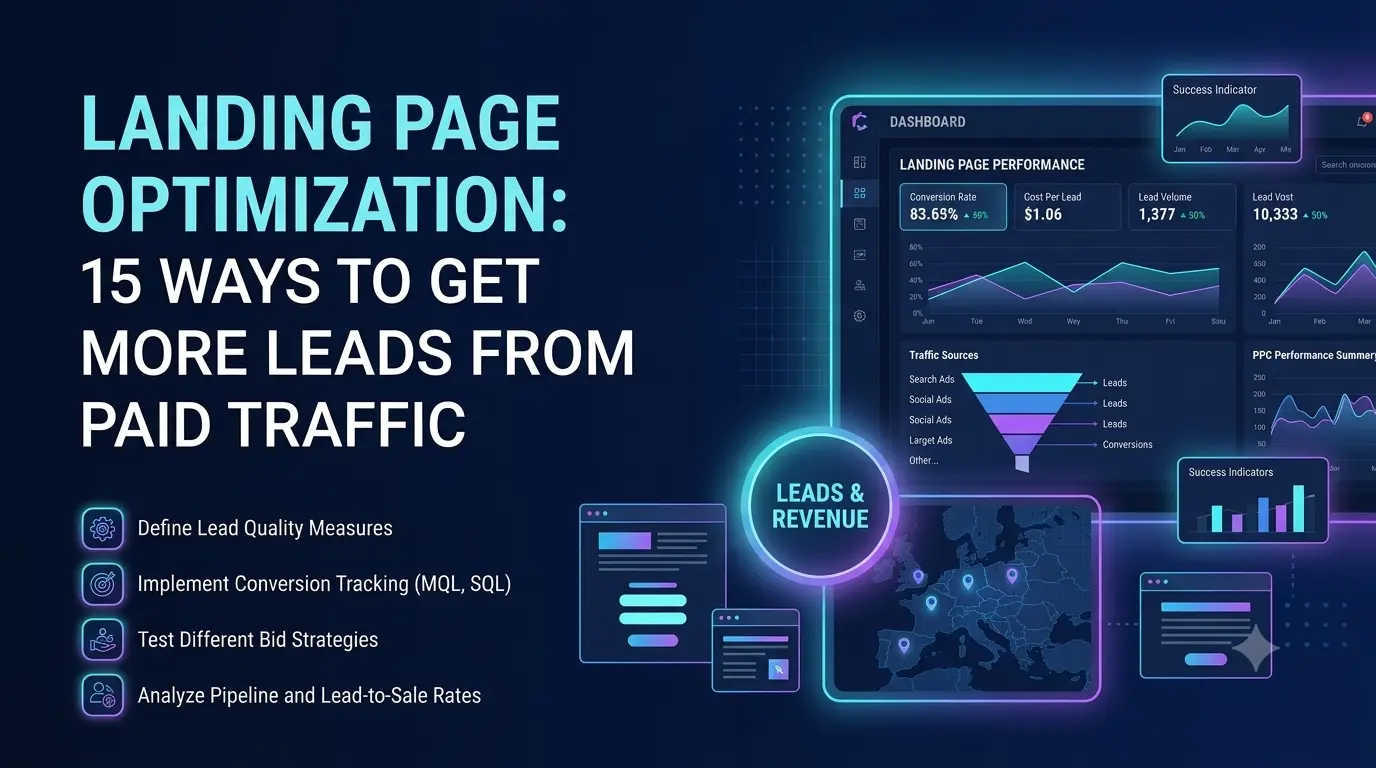
Landing Page Optimization: 15 Ways to Get More Leads From Paid Traffic
A great ad sending traffic to a mediocre landing page is one of the most common — and most fixable — ways paid advertising budget gets wasted.
The short answer
Landing page optimization is about removing every unnecessary reason a visitor might leave before converting — mismatched messaging, unclear offers, excessive form fields, slow load times, or missing trust signals. Since landing pages typically receive paid, deliberately acquired traffic, small conversion improvements have an outsized effect on return: the same ad spend produces meaningfully more leads without spending an additional dollar on traffic.
Message and offer clarity
- Match your headline to the ad that brought the visitor there. A visitor who clicked a specific ad expects to see that same message reflected immediately — any mismatch creates doubt about whether they landed in the right place.
- State the offer clearly and specifically, not vaguely. “Get started” tells a visitor less than “Get a free quote in 24 hours.”
- Keep the value proposition above the fold. Per Nielsen Norman Group’s eyetracking research, users spend roughly 57% of their page-viewing time above the fold — burying your core message below it means many visitors never see it at all.
- Use one primary call to action, not several competing asks that split attention and reduce action on all of them.
Trust and credibility
- Add relevant trust signals near the conversion point — reviews, certifications, client logos, or guarantees — right where the decision is actually being made.
- Use specific social proof, not generic praise. A testimonial from a customer in a similar situation is more persuasive than a vague, unattributed quote.
- Show real contact information and business legitimacy signals, especially for higher-consideration offers where trust matters more.
Form and friction
- Ask for only what you genuinely need at this stage — every additional field is a small new reason to abandon.
- Use single-column form layouts, which are generally easier to scan and complete than multi-column arrangements.
- Make the next step obvious after form submission, so visitors know what happens and aren’t left uncertain whether their action succeeded.
Technical and structural
- Optimize page load speed. Slow-loading landing pages lose visitors before the offer is even visible, especially on mobile.
- Remove standard site navigation on dedicated campaign landing pages, reducing the paths available away from the intended conversion.
- Design mobile-first, since a significant share of paid traffic — particularly from social and search on mobile devices — will land on a small screen first.
Testing and iteration
- Test one meaningful change at a time, so you can actually attribute a result to a specific change rather than several at once.
- Revisit and update landing pages periodically, since what converts well can shift as audience expectations, competitors, and ad creative change over time.
Why this connects directly to ad costs
Landing page quality isn’t just a conversion issue — for Google Ads specifically, it’s a direct input into Quality Score, which affects both ad position and cost per click. A stronger landing page can mean paying less for the same or better ad position, making landing page optimization one of the few conversion investments with a direct, measurable effect on acquisition cost too.
Where to start if you can only prioritize a few
| Situation | Start here |
|---|---|
| High ad spend, mediocre conversion | Message match, single CTA, load speed |
| Reasonable conversion, want to scale further | Trust signals, form friction, mobile experience |
| New campaign, unproven landing page | Build a dedicated page before scaling budget |
Common mistakes
- Sending paid traffic to a general homepage instead of a dedicated, message-matched landing page.
- Overloading the page with competing calls to action, diluting the one action that actually matters.
- Asking for too much information too soon, before the visitor has any reason to trust the exchange.
- Ignoring page speed, especially on mobile, where slow loads lose visitors before they even see the offer.
The bottom line
Landing page optimization is one of the highest-leverage, most directly measurable investments available to any business running paid traffic — because every improvement compounds against ad spend that’s already being paid for. Start with message match and a single clear call to action, reduce unnecessary friction in forms and navigation, and build trust exactly where the decision is being made. Small, deliberate changes here consistently outperform spending more to acquire additional traffic to the same underperforming page.
Frequently asked questions
Should paid traffic go to a dedicated landing page or my homepage?
A dedicated landing page almost always performs better for paid traffic, because it can match the specific ad's message and offer exactly, without the distractions and competing navigation of a general homepage built to serve many different visitor intents at once.
How much does landing page quality affect Google Ads cost?
Directly — landing page experience is one of the components Google factors into Quality Score, which affects both ad rank and cost per click. A poor landing page can mean paying more for the same position compared to a competitor with a stronger page.
What's the single highest-impact landing page change to test first?
Message match between the ad and the landing page headline is usually the highest-leverage starting point — if a visitor doesn't immediately see the same offer or language that got them to click, they're significantly more likely to leave regardless of how well-designed the rest of the page is.
How many form fields should a landing page have?
As few as the offer genuinely requires. Every additional field is a small additional reason to abandon, so each one should earn its place — ask only for what's truly needed at this stage of the relationship.
Should a landing page have website navigation?
Often not, or at least a reduced version. A dedicated landing page built for one specific offer generally converts better with fewer distractions pulling attention away from the single intended action, unlike a homepage designed to support many different paths.
More insights
Conversion Optimization
What Is Conversion Rate Optimization (CRO) and Why Does It Matter?
Most businesses spend far more trying to get new traffic than trying to convert the traffic they already have. CRO fixes that imbalance.
Read Article
Paid Advertising
Google Ads Quality Score: How to Improve It and Lower Ad Costs
Two advertisers can bid the same amount and pay very different prices for the same position. Quality Score is usually why.
Read Article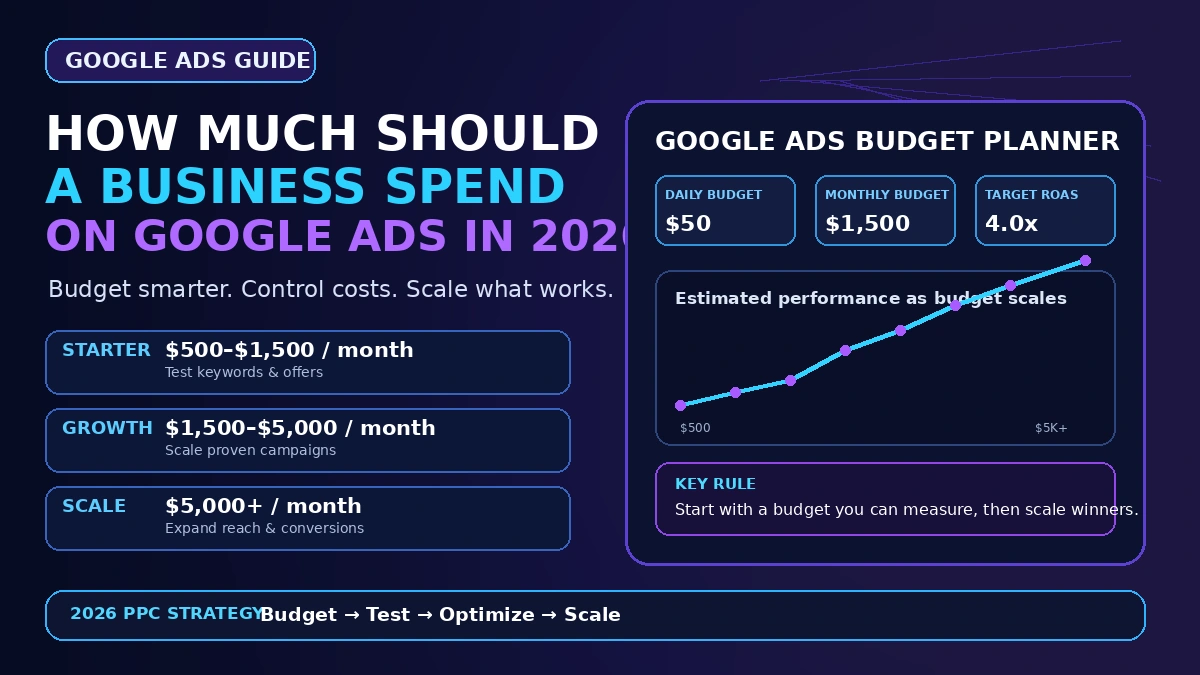
Paid Advertising
How Much Should a Business Spend on Google Ads in 2026?
Anyone who gives you a single dollar figure without knowing your industry, margins, and goals is guessing. Here's how to actually calculate a Google Ads budget that makes sense for your business.
Read ArticleNeed support?
Ready to grow your business?
Related services: Web Design & Development, Paid Advertising / PPC