
Conversion Optimization
What Is Conversion Rate Optimization (CRO) and Why Does It Matter?
Most businesses spend far more trying to get new traffic than trying to convert the traffic they already have. CRO fixes that imbalance.
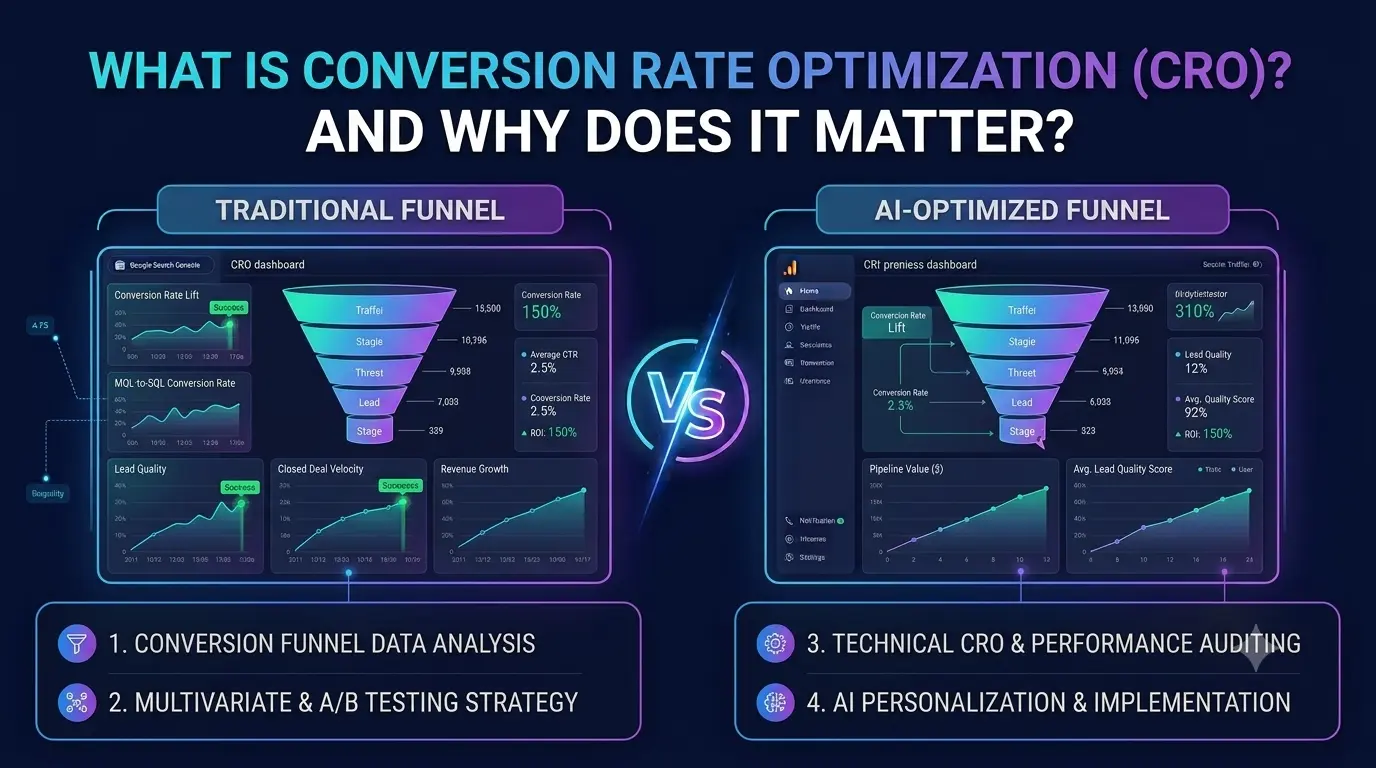
The short answer
Conversion rate optimization (CRO) is the practice of systematically improving the percentage of website visitors who take a desired action — making a purchase, submitting a form, booking a call — without needing to increase traffic at all. It matters because most businesses spend significantly more effort and budget trying to attract new visitors than trying to convert the visitors they already have, even though improving conversion is often faster, cheaper, and compounds the value of every other marketing channel already in use.
Why CRO has outsized leverage
Every marketing channel — SEO, paid ads, social, email — ultimately funnels people to the same website experience. If that experience converts poorly, improvements to any single channel are working against a leaky foundation. Improving conversion rate, by contrast, makes every existing channel more valuable simultaneously: the same traffic from SEO, the same clicks from paid ads, all convert at a higher rate without any additional acquisition spend.
What CRO actually involves
- Identifying real friction points in the current experience — confusing navigation, unclear offers, overly demanding forms, missing trust signals.
- Forming specific, testable hypotheses about what’s causing visitors to leave without converting, rather than guessing at random changes.
- Making deliberate, evidence-informed changes to page copy, layout, calls to action, or forms.
- Measuring the actual impact of those changes against a clear baseline, ideally through structured testing where volume allows.
- Iterating continuously, since conversion optimization isn’t a single project with a defined end point — it’s an ongoing practice as the site, audience, and competition evolve.
Where CRO overlaps with other disciplines
CRO sits closely alongside turning existing traffic into leads and landing page optimization — in practice, the same underlying principles (clarity, reduced friction, relevant trust signals) apply across all three, just at different scales: site-wide CRO thinking, specific traffic-to-lead tactics, and individual landing page execution.
A simple way to think about priority
| Situation | CRO leverage |
|---|---|
| High traffic, low conversion rate | Very high — meaningful room to improve without spending more on acquisition |
| Low traffic, reasonable conversion rate | Lower immediate leverage — traffic growth may matter more right now |
| High traffic, already well-optimized | Lower marginal leverage — smaller, harder-won gains from here |
Businesses with substantial existing traffic and an unoptimized experience typically have the most to gain from CRO as a first investment, before spending more to acquire additional traffic.
Measuring whether CRO efforts are working
Improvements should ultimately be judged by whether they move a real business outcome — leads, sales, qualified inquiries — not just a superficial metric like time on page. This ties directly into properly measuring digital marketing ROI, since a conversion rate improvement that doesn’t translate into a better business outcome isn’t actually the win it might appear to be on the surface.
Common mistakes in CRO
- Making changes based on personal preference rather than evidence about what’s actually causing visitors to leave.
- Testing too many things at once, making it impossible to know which specific change caused a result.
- Focusing only on the homepage, when the highest-leverage opportunities are often on high-traffic landing or product pages instead.
- Treating CRO as a one-time project rather than an ongoing practice that needs revisiting as the site and audience change.
The bottom line
CRO is one of the highest-leverage investments available to a business that already has meaningful traffic, because it improves the return on every other marketing channel simultaneously rather than requiring new spend to acquire more visitors. Start by honestly identifying friction on your highest-traffic pages, make deliberate rather than arbitrary changes, and measure against real business outcomes — not vanity metrics — to know whether the effort is actually working.
Frequently asked questions
Is CRO only relevant for e-commerce websites?
No — CRO applies to any website with a goal, whether that's a purchase, a form submission, a phone call, or a booking. Service businesses, B2B companies, and lead-generation sites all have conversion points worth optimizing, not just online stores.
What's a realistic first step for a business new to CRO?
Start by clearly identifying your actual conversion goal on your highest-traffic pages, then honestly assess whether the current experience makes that goal obvious and low-friction. Small, specific fixes to high-traffic pages usually deliver more value early on than a broad, unfocused overhaul.
How is CRO different from SEO?
SEO focuses on getting more people to your site; CRO focuses on getting more value out of the people already there. They're complementary, not competing — improving conversion rate makes existing SEO and paid traffic more valuable without needing to acquire more of it.
Do I need A/B testing software to do CRO?
Not necessarily to start. Many meaningful early improvements — clarifying a call to action, shortening a form, adding trust signals — don't require formal A/B testing to justify, though testing becomes more valuable once you're refining smaller, less obvious changes.
How much can conversion rate realistically improve?
It varies enormously by starting point, industry, and how much friction currently exists in the experience. A site with significant unaddressed friction (a confusing form, an unclear offer) often has more room for meaningful improvement than one that's already reasonably well-optimized.
More insights
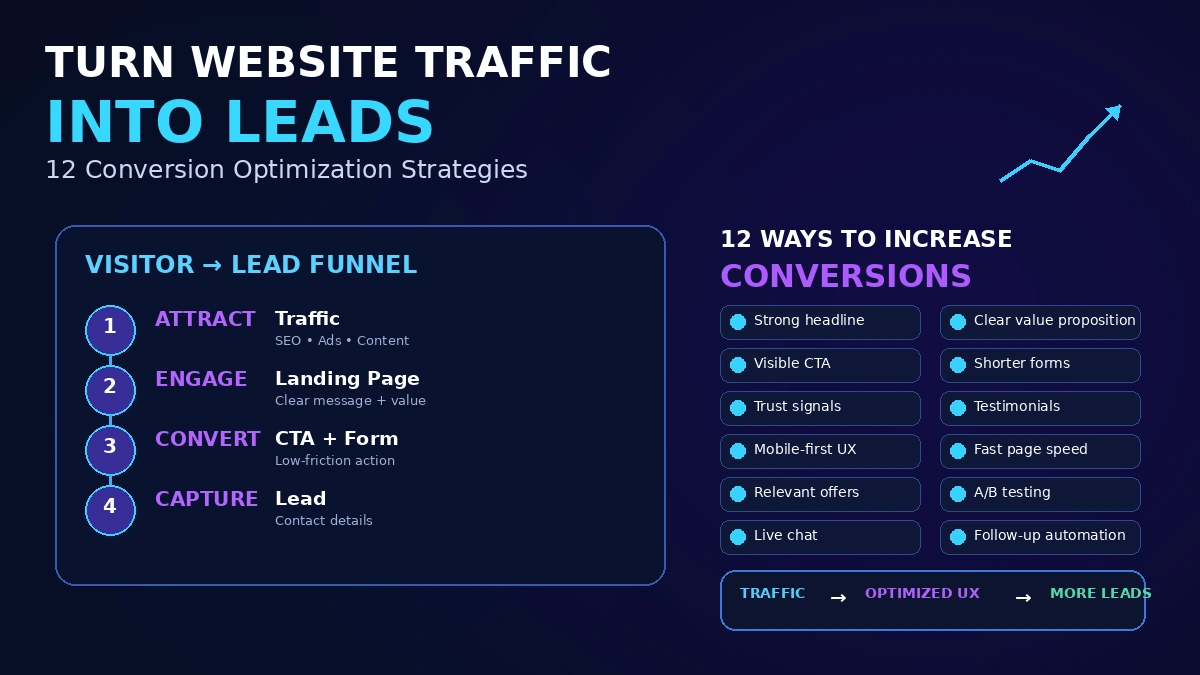
Conversion Optimization
How to Turn Website Traffic Into Leads: 12 Conversion Optimization Strategies
Most businesses have a traffic problem they're trying to solve with more traffic, when the real problem is that the traffic they already have isn't converting.
Read Article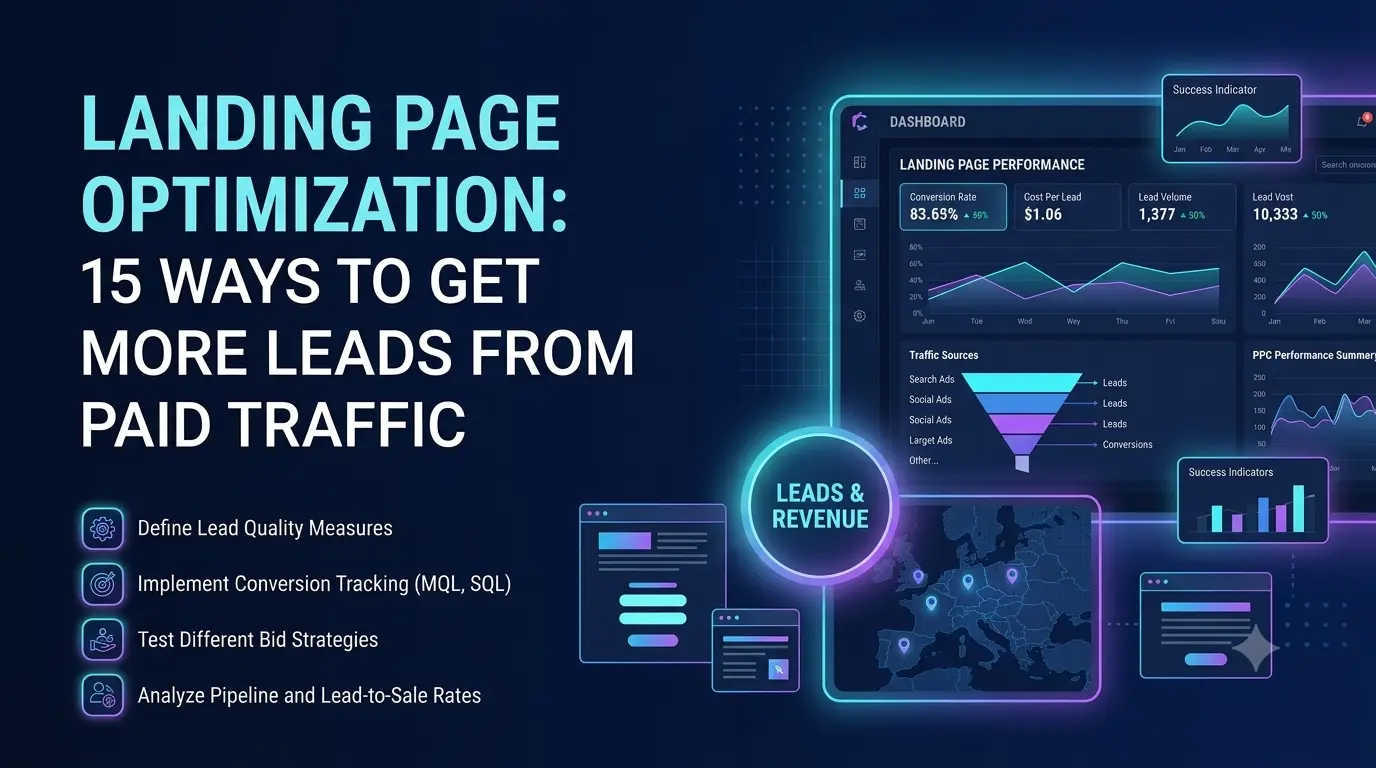
Conversion Optimization
Landing Page Optimization: 15 Ways to Get More Leads From Paid Traffic
A great ad sending traffic to a mediocre landing page is one of the most common — and most fixable — ways paid advertising budget gets wasted.
Read Article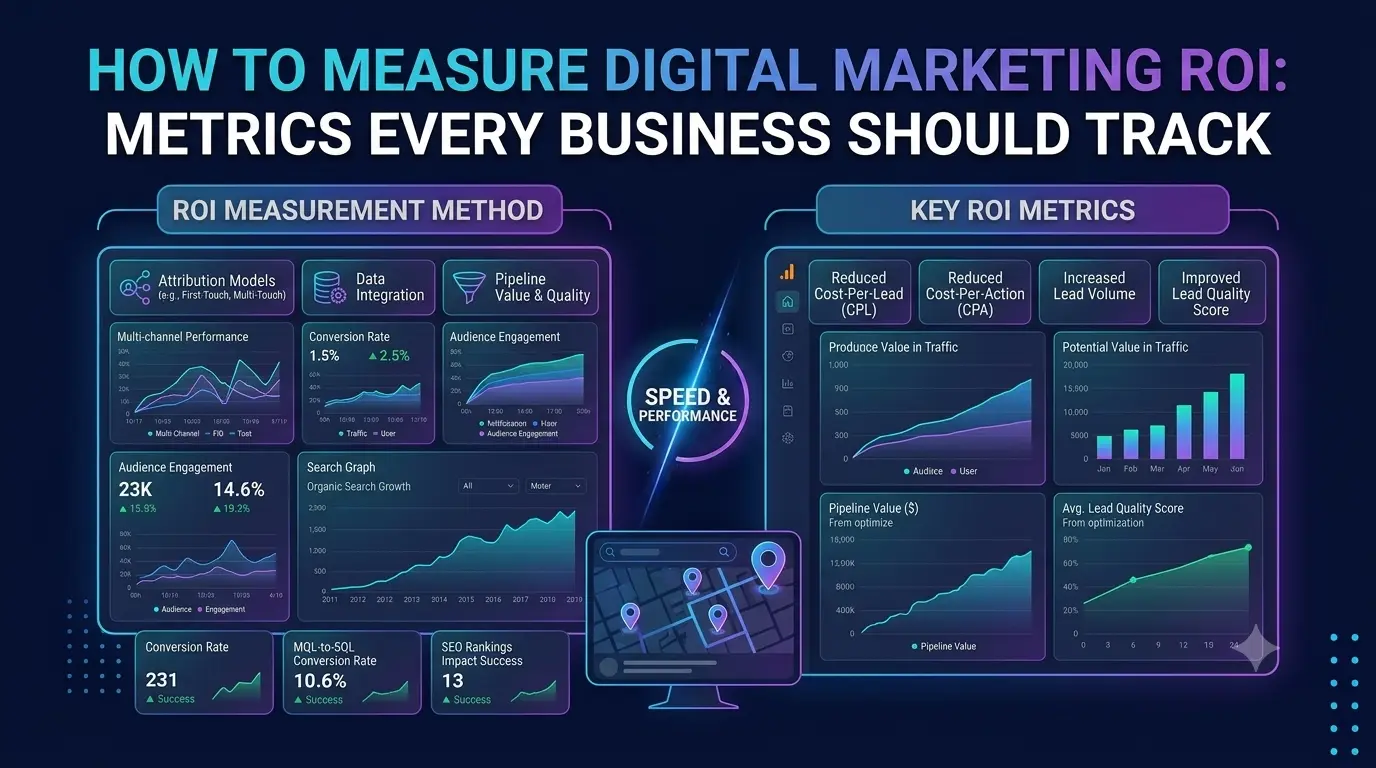
Digital Marketing Strategy
How to Measure Digital Marketing ROI: Metrics Every Business Should Track
Traffic, impressions, and likes are easy to report and rarely tell you whether marketing is actually working. Here's what to measure instead.
Read Article