
Paid Advertising
Google Ads Quality Score: How to Improve It and Lower Ad Costs
Two advertisers can bid the same amount and pay very different prices for the same position. Quality Score is usually why.
The short answer
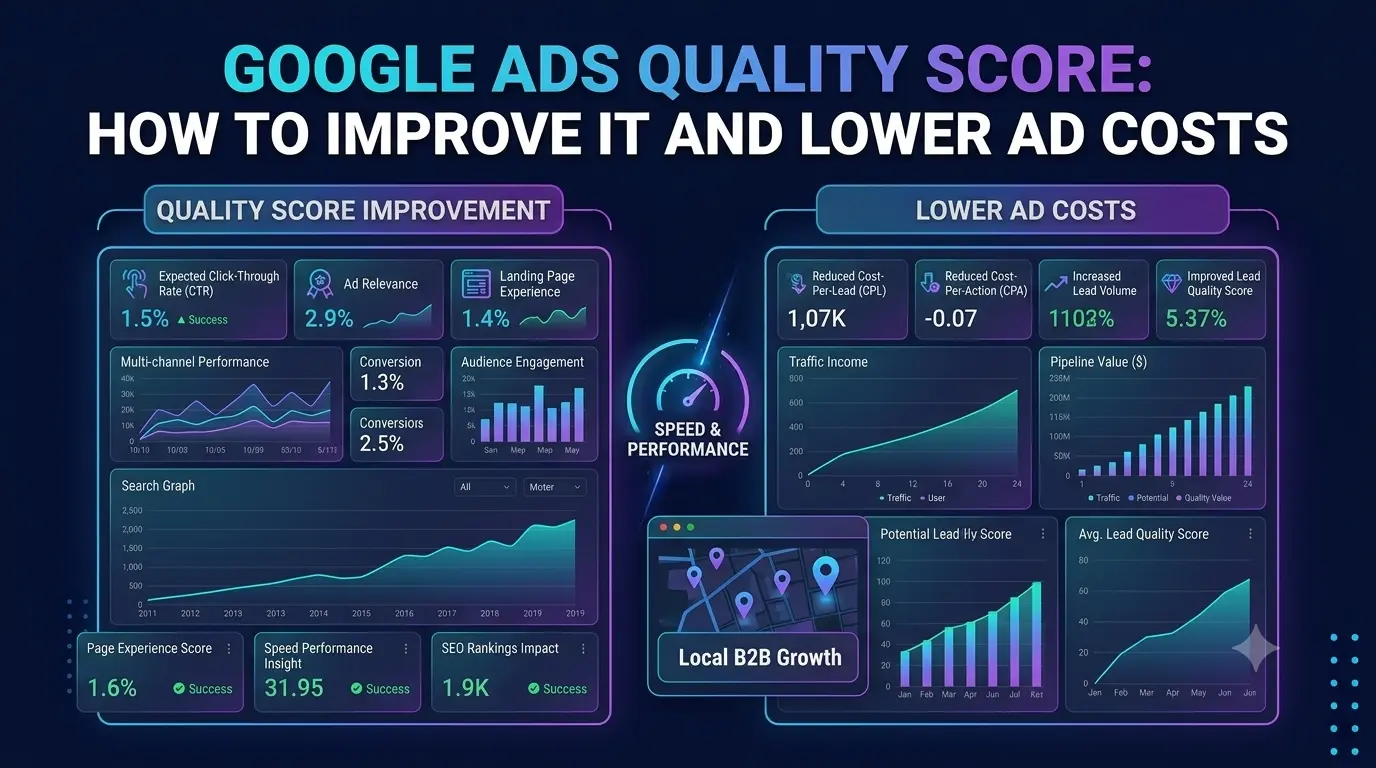
Google Ads Quality Score is Google’s own diagnostic rating of how relevant and useful your ads and landing pages are to the people searching for your keywords. Per Google’s own Ads Help documentation, it’s built from three components — expected clickthrough rate, ad relevance, and landing page experience — each rated Above Average, Average, or Below Average compared to other advertisers competing for the exact same searches. While Quality Score itself isn’t a direct input into the ad auction, the underlying signals it reports on do factor into Ad Rank, which means a genuinely better Quality Score reliably correlates with lower costs for the same ad position.
The three components, explained
- Expected clickthrough rate (CTR) — how likely your ad is to be clicked when shown for a given keyword, based on historical performance data.
- Ad relevance — how closely your ad’s actual message matches the intent behind the search term.
- Landing page experience — how relevant, useful, and easy to navigate your landing page is for someone who clicks through from that specific ad.
Per Google’s documentation, each is evaluated relative to other advertisers whose ads showed for the exact same search over a recent window — so Quality Score is inherently competitive and relative, not an absolute score based on fixed criteria alone.
Why Quality Score matters even though it’s not a direct auction input
Google is explicit that Quality Score itself is a diagnostic tool, not a literal input into the auction. But the three components behind it — expected CTR, ad relevance, and landing page experience — are closely related to the actual signals that do factor into Ad Rank. In practice, this means genuinely improving the things Quality Score measures tends to lower your effective cost per click for the same position, even though you’re not “optimizing for the score” directly so much as optimizing the real underlying experience it reflects.
How to actually improve each component
Improving expected CTR:
- Write ad copy that directly speaks to the specific keyword’s intent, not generic messaging reused across many keywords.
- Use ad extensions to provide more relevant information and increase the ad’s visibility and appeal.
- Group keywords tightly by theme so each ad can be genuinely specific to a narrow set of related terms.
Improving ad relevance:
- Keep ad groups tightly themed around closely related keywords, rather than broad groupings that force generic ad copy.
- Make sure headline and description copy genuinely reflects what the keyword implies the searcher wants.
Improving landing page experience:
- Ensure message match between the ad and the landing page — the offer and language should feel continuous, not disconnected.
- Improve page load speed and mobile usability, both of which factor into how Google assesses landing page quality.
- Make the page genuinely relevant and useful to the specific keyword, not just to the broader campaign topic — this overlaps directly with core landing page optimization practices.
Why this connects directly to your budget
A low Quality Score effectively means paying more to achieve the same ad position as a competitor with a higher score — which directly affects how far your Google Ads budget actually stretches. Improving Quality Score isn’t a vanity metric exercise; it’s one of the more direct, controllable ways to lower real advertising costs without reducing bids or budget.
Common mistakes
- Chasing the Quality Score number directly rather than genuinely improving the underlying ad relevance and landing page experience it reflects.
- Using overly broad ad groups that force generic ad copy across many loosely related keywords.
- Sending all keywords to the same generic landing page, regardless of how specific or different their search intent actually is.
- Ignoring landing page speed and mobile experience, both of which factor directly into the landing page experience component.
The bottom line
Quality Score is Google’s own transparent explanation of what makes an ad experience genuinely good — relevant messaging, accurate targeting, and a landing page that delivers on what the ad promised. It’s not a score to game directly; it’s a diagnostic reflecting real advertiser quality relative to competitors bidding on the same searches. Improving the three underlying components consistently lowers real advertising costs, making Quality Score one of the more directly actionable levers available in a Google Ads account.
Frequently asked questions
Is Quality Score a direct part of the ad auction?
No, and Google is explicit about this — Quality Score is a diagnostic tool, not a direct auction input. What actually factors into the auction is Ad Rank, which draws on the same underlying signals (expected CTR, ad relevance, landing page experience) that Quality Score reports on, so improving the components behind Quality Score does genuinely help auction performance even though the score itself isn't the direct input.
What's a good Quality Score?
Quality Score is shown on a 1–10 scale, but the more actionable information is in its three underlying components — expected CTR, ad relevance, and landing page experience — each rated Above Average, Average, or Below Average. A below-average rating on any component is a concrete, specific signal of where to improve, more useful than the single overall number.
How quickly can Quality Score improve after making changes?
It varies, since Google's assessment is based on accumulated performance data over time, not an instant recalculation. Meaningful, sustained improvements to ad relevance and landing page quality typically show up gradually rather than immediately after a single change.
Does Quality Score affect all keywords equally?
No — Quality Score is calculated per keyword, since relevance and landing page fit can vary significantly across the different keywords in a single campaign, even when they're all pointing to the same ad and landing page.
Can a high bid compensate for a low Quality Score?
To some extent in the auction, since Ad Rank factors in both bid and quality-related signals, but a low Quality Score generally means paying more for the same position compared to a higher-quality competitor — so relying purely on bid to compensate is typically a more expensive path than improving the underlying quality signals.
More insights
Paid Advertising
How Much Should a Business Spend on Google Ads in 2026?
Anyone who gives you a single dollar figure without knowing your industry, margins, and goals is guessing. Here's how to actually calculate a Google Ads budget that makes sense for your business.
Read Article
Conversion Optimization
Landing Page Optimization: 15 Ways to Get More Leads From Paid Traffic
A great ad sending traffic to a mediocre landing page is one of the most common — and most fixable — ways paid advertising budget gets wasted.
Read Article
Paid Advertising
Google Ads vs Meta Ads: Which Advertising Platform Is Better for Your Business?
Google Ads catches people already searching for a solution. Meta Ads reaches people who aren't searching yet. Here's what that difference actually means for your budget.
Read Article