
Paid Advertising
How Much Should a Business Spend on Google Ads in 2026?
Anyone who gives you a single dollar figure without knowing your industry, margins, and goals is guessing. Here's how to actually calculate a Google Ads budget that makes sense for your business.
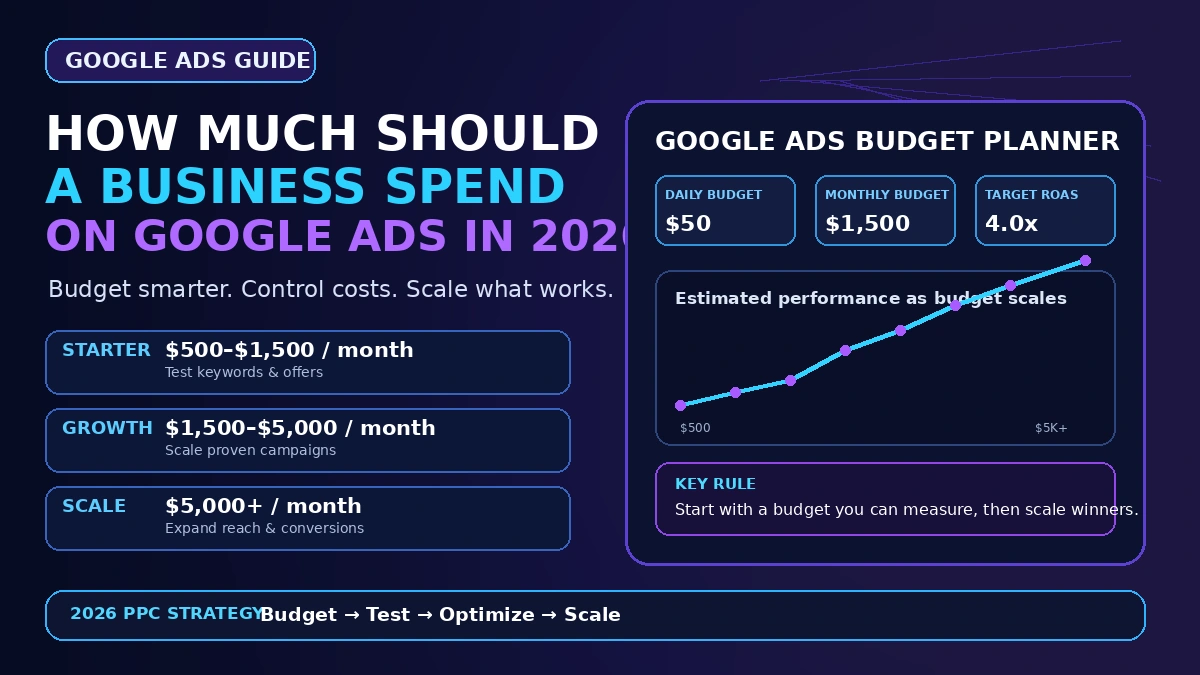
The short answer
There’s no single right number — a realistic Google Ads budget depends on your industry’s typical cost per click, how many conversions you need to make informed decisions, and what a customer is actually worth to your business. According to WordStream’s 2026 Search Advertising Benchmarks report, average cost per click across industries ranges from around $1.63 (arts and entertainment) to nearly $9.87 (attorneys and legal services) — a roughly six-fold difference that makes any generic “spend $X per month” advice close to meaningless without knowing your specific industry.
Start with your industry’s real cost per click
The same WordStream report puts the 2026 all-industry average Search CPC at $5.42, with average cost per lead around $66.69 — but these are averages across thousands of accounts, not a prediction for your specific business. Your actual costs depend on your keywords, competition in your exact market, and your Quality Score. Use industry benchmarks as a starting reference point, not a target.
A practical way to calculate your starting budget
- Find your industry’s approximate CPC from a benchmark report like WordStream’s, or your own historical Google Ads data if you have it.
- Decide how many clicks you need per month to generate enough conversions to learn something — a small handful of conversions isn’t enough data to optimize from.
- Multiply CPC by target clicks to get a rough monthly floor. If your industry averages $5 CPC and you want at least 100 clicks a month to gather meaningful data, that’s roughly $500/month as a starting point — before accounting for your specific competition.
- Sanity-check against customer value. If your average customer is worth $50, a $60 cost per lead may not be sustainable. If your average customer is worth $2,000, it likely is.
Daily budgets vs. shared budgets
Per Google’s own Ads Help documentation, you can set an average daily budget for an individual campaign, or a shared budget that Google allocates dynamically across multiple campaigns based on performance. For most small accounts running one or two focused campaigns, individual daily budgets are simpler to manage and understand. Shared budgets become more useful once you’re running several related campaigns and want Google’s system to shift spend toward whichever is performing best.
Why “spend more” isn’t always the right answer
Increasing budget only helps once the fundamentals are working — relevant keywords, strong ad copy, and a landing page that actually converts. Pouring more budget into a campaign with poor Quality Score or a weak landing page mostly just increases how much you spend to get the same (or worse) results, rather than improving them. This is closely tied to Quality Score, which directly affects how much you pay for the same position.
A simple monthly budget framework
| Business stage | Reasonable approach |
|---|---|
| Testing / new account | Modest budget focused on 1–2 tightly defined campaigns, prioritizing learning over scale |
| Validated, converting campaigns | Gradually increase budget on what’s already proven to convert |
| Scaling | Expand into adjacent keywords/campaigns, informed by what’s already working |
Common budgeting mistakes
- Copying a competitor’s assumed budget without knowing their margins, conversion rates, or actual customer value.
- Judging performance too early, before enough clicks or conversions have accumulated to draw a real conclusion.
- Ignoring cost per conversion in favor of just watching cost per click, which tells you almost nothing about whether the spend is actually profitable.
- Scaling budget on an unproven campaign instead of fixing targeting, ad copy, or the landing page first.
The bottom line
A Google Ads budget should be built from your industry’s real cost per click, the volume of data you need to optimize intelligently, and what a converted customer is actually worth to your business — not copied from a generic number floating around online. Start with a budget large enough to gather real data, track cost per conversion against customer value rather than cost per click alone, and only scale spend once you can see it’s genuinely working.
Frequently asked questions
What's a realistic minimum monthly Google Ads budget?
It depends entirely on your industry's cost per click and how many conversions you need to gather meaningful data. A business in a low-CPC industry might see useful data from a few hundred dollars a month, while a business in a high-CPC industry like legal services may need a much larger budget just to get enough clicks to learn anything.
Why is my cost per click so much higher than the industry average?
Averages published in industry reports are just that — averages across thousands of accounts. Your actual CPC depends on your specific keywords, competition in your exact market, ad quality, and Quality Score, so meaningful variance from a benchmark isn't automatically a problem.
Should I set a daily budget or a shared budget across campaigns?
Per Google's own guidance, a daily budget suits a single, well-defined campaign, while a shared budget makes sense when you want Google to allocate spend across multiple related campaigns based on where it's performing best. Most small accounts start simpler with individual daily budgets per campaign.
Does spending more automatically get better results?
No. Budget increases only help once your targeting, ad quality, and landing pages are already converting reasonably well — increasing spend on an underperforming campaign usually just accelerates how much you lose, not how much you gain.
How do I know if my Google Ads budget is actually working?
Track cost per conversion (or cost per lead) against what a customer is actually worth to your business, not just clicks or impressions. A campaign with a high cost per click can still be profitable if conversion rate and customer value are strong enough — and a cheap-looking campaign can still lose money if it isn't converting.
More insights
Paid Advertising
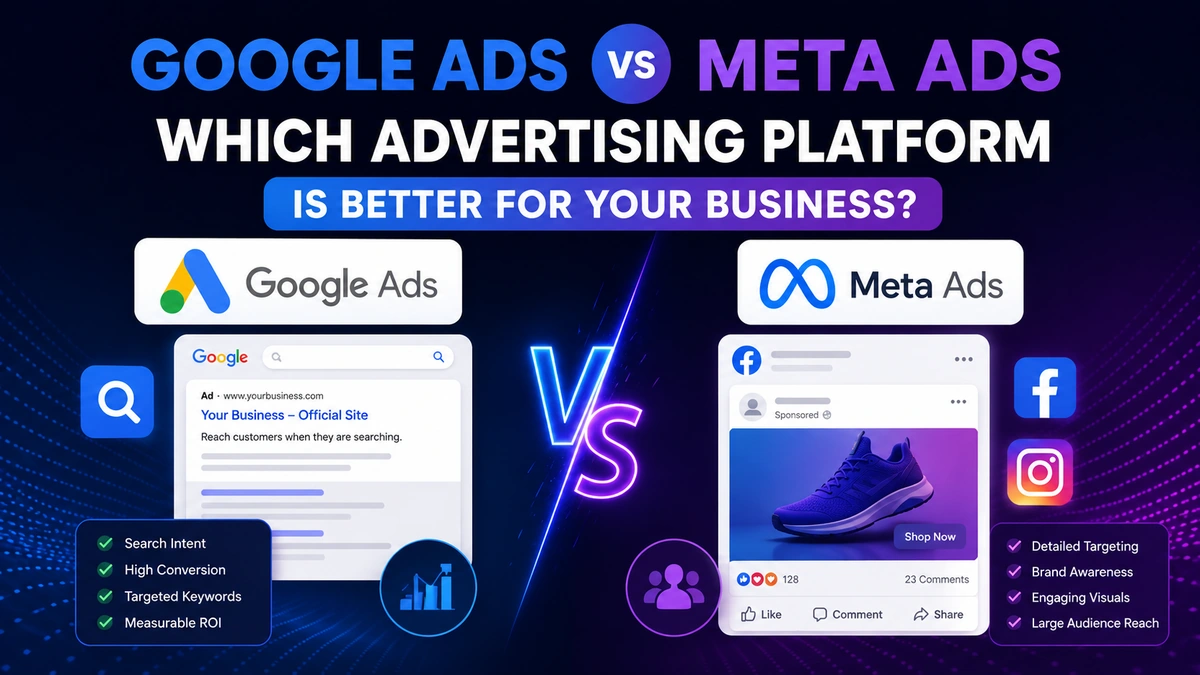
Google Ads vs Meta Ads: Which Advertising Platform Is Better for Your Business?
Google Ads catches people already searching for a solution. Meta Ads reaches people who aren't searching yet. Here's what that difference actually means for your budget.
Read Article
Paid Advertising
Google Ads Quality Score: How to Improve It and Lower Ad Costs
Two advertisers can bid the same amount and pay very different prices for the same position. Quality Score is usually why.
Read Article
Conversion Optimization
Landing Page Optimization: 15 Ways to Get More Leads From Paid Traffic
A great ad sending traffic to a mediocre landing page is one of the most common — and most fixable — ways paid advertising budget gets wasted.
Read Article