
Paid Advertising
Google Ads vs Meta Ads: Which Advertising Platform Is Better for Your Business?
Google Ads catches people already searching for a solution. Meta Ads reaches people who aren't searching yet. Here's what that difference actually means for your budget.
The short answer
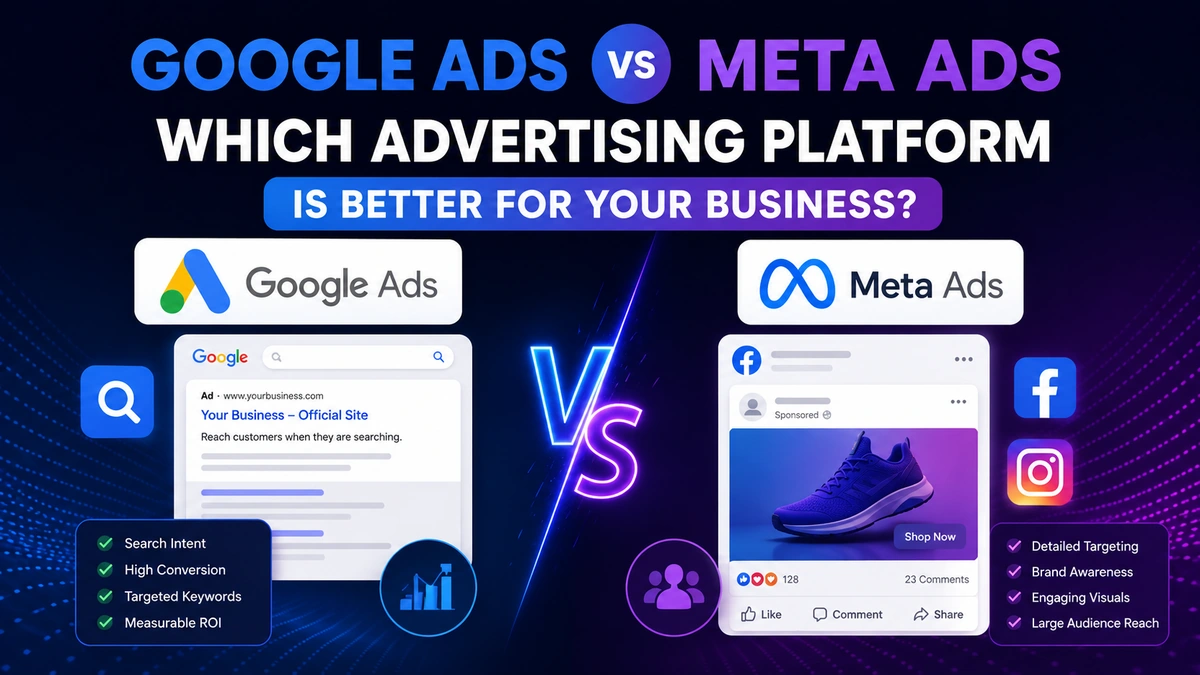
Google Ads and Meta Ads aren’t really competitors for the same budget line — they solve different problems. Google Ads shows your business to people who are actively searching for what you offer, right when they’re looking. Meta Ads shows your business to people based on interests, behavior, and demographics, often before they’re consciously looking for a solution at all. The right platform depends less on which one is “better” and more on whether your customers typically search for what you sell, or need to be introduced to it.
How each platform actually decides what to show
Google Ads runs a real-time auction every time someone searches. Per Google’s own Ads Help documentation, six main factors determine which ads appear and in what position — including your bid and Google’s assessment of your ad and landing page quality — and the auction uses a modified second-price mechanism, meaning you typically pay just enough to beat the advertiser below you, not your full maximum bid.
Meta Ads runs a separate auction for every available placement across Facebook, Instagram, and Messenger. Per Meta’s own Business Help Center, the auction winner is determined by bid amount, estimated action rate (how likely that specific person is to engage), and ad quality — explicitly designed so a higher bid alone doesn’t guarantee the win if a competing ad is more relevant to that person.
The core difference: intent vs. discovery
| Google Ads | Meta Ads | |
|---|---|---|
| How people find you | They search for what you offer | You’re shown based on interests/behavior |
| Buyer intent | Generally high — they’re actively looking | Generally lower — often pre-need-awareness |
| Best for | Capturing existing demand | Creating awareness, remarketing |
| Creative format | Mostly text-based, intent-driven | Highly visual, scroll-stopping |
| Typical funnel stage | Middle to bottom | Top to middle |
When Google Ads is the stronger starting point
- Your product or service has clear, searchable demand (people already type queries related to what you sell).
- You want to capture people close to a buying decision.
- Your offer is easy to explain in a headline and a couple of lines of ad copy.
This overlaps significantly with when SEO is the stronger long-term investment too — both channels work best when real search demand already exists for what you’re selling.
When Meta Ads is the stronger starting point
- You’re introducing a new or unfamiliar product category.
- Your offer benefits from strong visual storytelling.
- You want to build a remarketing audience before investing heavily in search.
- Your ideal customer is well-defined by interests, behaviors, or demographics rather than active search terms.
Why many businesses eventually run both
A common, effective pattern: Google Ads captures people who are ready to act right now, while Meta Ads builds awareness and remarkets to people who visited your site (from any source) but didn’t convert yet. Used together, Meta often supports the top of the funnel while Google Ads closes the bottom — rather than the two platforms competing for the same budget in isolation.
Common mistakes when choosing between them
- Picking a platform based on where competitors advertise, rather than where your specific customers actually behave.
- Judging Meta Ads by search-intent standards, then abandoning it as “not working” when it was never designed to capture the same kind of intent as search.
- Underinvesting in landing pages. Both platforms reward — and both auctions explicitly factor in — landing page relevance and quality, not just the ad itself.
- Splitting a small budget evenly across both before either has enough spend to gather meaningful data, rather than concentrating budget where intent is clearest first.
The bottom line
There’s no universal winner between Google Ads and Meta Ads — the right starting point depends on whether your customers are actively searching for what you offer or need to be introduced to it. Most mature marketing programs eventually use both, with Google Ads capturing existing demand and Meta Ads building and remarketing to an audience that isn’t searching yet. Start with the platform that matches how your actual customers behave, then expand once you understand what’s converting.
Frequently asked questions
Should a new business start with Google Ads or Meta Ads?
It depends on whether your product solves a problem people are actively searching for. If customers already type your kind of product or service into Google, paid search tends to convert faster. If you're introducing something people don't yet know they want, Meta's interest and behavior-based targeting is often more effective at creating that initial demand.
Is Meta Ads cheaper than Google Ads?
Cost varies enormously by industry and competition on both platforms, so there's no universally cheaper option. What differs more consistently is intent — a Google Ads click usually reflects someone actively looking for a solution, while a Meta Ads click often reflects someone discovering interest in the moment, which affects how each cost should be evaluated.
Can I run both platforms at the same time?
Yes, and for many businesses this is the strongest approach — Google Ads capturing existing demand while Meta Ads builds awareness and remarkets to people who've already shown interest, including visitors from your Google Ads campaigns.
Does Meta Ads work for B2B businesses?
It can, particularly for awareness, retargeting website visitors, and reaching decision-makers based on job title or interests, but B2B buying cycles are often longer and more research-driven, which tends to favor search-based platforms for capturing bottom-of-funnel intent.
What's the biggest mistake businesses make comparing these platforms?
Judging both platforms by the same metric. Comparing a Google Ads click (usually higher intent) directly against a Meta Ads click (usually lower immediate intent, higher volume) without accounting for where each person is in their decision process leads to comparing two fundamentally different things as if they were interchangeable.
More insights
Digital Marketing Strategy
SEO vs Google Ads: Which Is Better for Business Growth in 2026?
SEO and Google Ads solve different problems. Here's how each one actually works, what it costs you in time versus budget, and a practical framework for deciding where to invest first.
Read Article
Paid Advertising
How Much Should a Business Spend on Google Ads in 2026?
Anyone who gives you a single dollar figure without knowing your industry, margins, and goals is guessing. Here's how to actually calculate a Google Ads budget that makes sense for your business.
Read Article
Paid Advertising
Google Ads Quality Score: How to Improve It and Lower Ad Costs
Two advertisers can bid the same amount and pay very different prices for the same position. Quality Score is usually why.
Read Article