
Digital Marketing Strategy
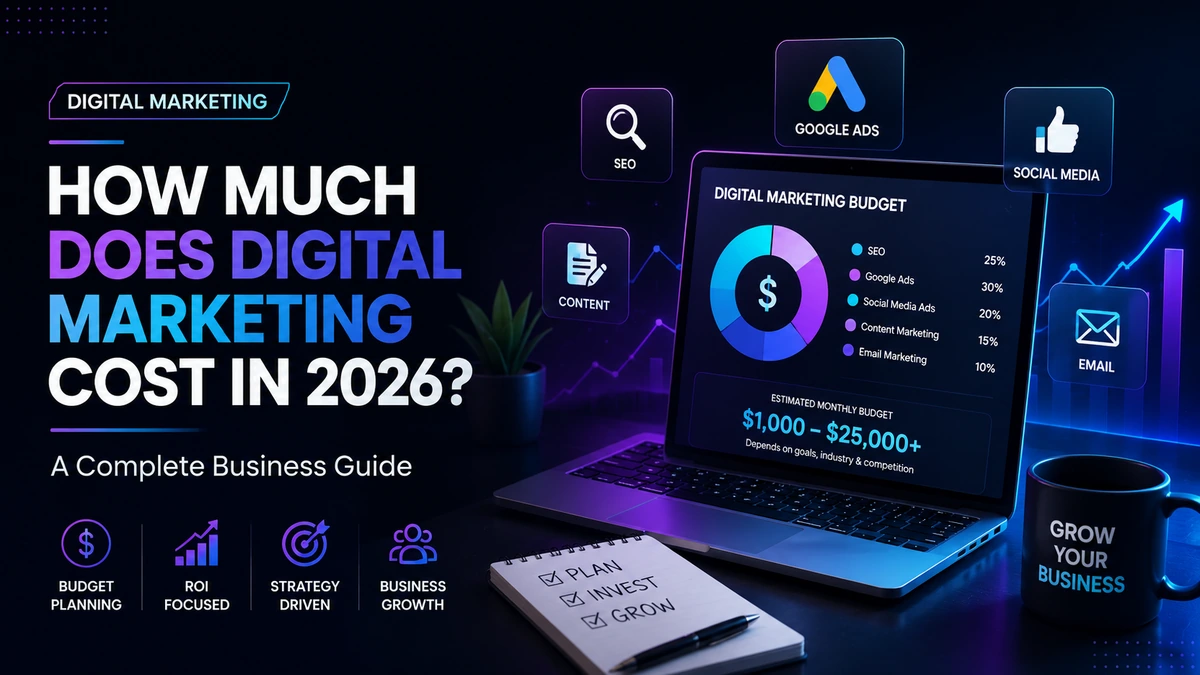
How Much Does Digital Marketing Cost in 2026? A Complete Business Guide
Digital marketing costs vary more than almost any other business expense, because the number depends less on the channel and more on your goals, competition, and stage. Here's how to actually budget for it.
The short answer
There’s no single number, and any guide that gives you one without asking about your business first is guessing. What you can budget on is a range: most small and mid-sized businesses spend somewhere between a few hundred and several thousand dollars a month on digital marketing, with the total driven by which channels you use, how competitive your industry is, and whether you’re paying for management, ad spend, or both.
A more useful starting point than a flat number is a percentage of revenue. The U.S. Small Business Administration’s guidance on setting a marketing budget points to roughly 6–12% of gross revenue for most small businesses, varying by whether you sell to consumers or other businesses, and by product versus service.
The rest of this guide breaks down what actually drives that number up or down, typical pricing by channel, and how to build a budget that matches where your business actually is.
What actually determines digital marketing cost
Before looking at price ranges, it helps to understand the handful of variables that explain why two businesses in the same industry can pay very different amounts for what looks like the same service:
- Scope of work. A “full SEO service” can mean a monthly blog post and a few technical fixes, or it can mean ongoing content strategy, link building, technical audits, and conversion optimization. Same label, very different cost.
- Competitiveness of your market. Ranking or advertising in a category with hundreds of competitors bidding on the same keywords costs more than a niche with little competition — this is true for both SEO effort and Google Ads bids.
- Business size and complexity. More products, more locations, or more service lines generally means more pages, more campaigns, and more ongoing management.
- Where you are in your growth stage. A brand-new business usually needs to spend more, proportionally, to build initial visibility than an established one with existing traffic and reputation.
- Whether you’re paying for management, spend, or both. This is the single most common source of confusion — see the next section.
Management fees vs. ad spend: a distinction worth understanding
When it comes to paid advertising specifically, there are two separate costs that often get lumped together:
- Ad spend — the money paid directly to the ad platform (Google, Meta, etc.) for the clicks or impressions themselves.
- Management fee — what you pay an agency or freelancer to plan, build, and optimize those campaigns.
According to Google Ads Help’s explanation of cost-per-click, you’re typically charged by Google only when someone clicks your ad — that spend goes to Google, not your agency. On top of that, agencies commonly charge a separate management fee, often structured as a percentage of ad spend or a flat monthly rate.
This matters because a “$1,000/month Google Ads package” could mean $1,000 total (management fee eating most of the actual ad spend) or $1,000 in management on top of a separate ad budget — two very different offers that are easy to confuse when comparing quotes.
For context on typical click costs: WordStream’s 2026 Google Ads benchmark report, based on data across thousands of campaigns, puts the average cost-per-click at $5.42 — but with enormous variation by industry, from roughly $1.63 in arts and entertainment up to nearly $9.87 for legal services. Your actual cost per click depends entirely on your category, not on a single industry-wide average.
Common digital marketing pricing models
Most digital marketing services are sold under one of four pricing structures:
| Model | How it works | Best fit for |
|---|---|---|
| Monthly retainer | A fixed recurring fee for ongoing work | SEO, paid media management, content, social media |
| Project-based | A fixed price for a defined, finite deliverable | Website builds, brand identity, one-time audits |
| Hourly | Billed by time spent | Ad hoc work, consulting, smaller scopes |
| Performance-based | Fees tied to results (leads, sales, or a revenue share) | Channels with clear, directly attributable conversions |
Retainers dominate ongoing SEO and paid media work because both channels require continuous attention — a campaign or a ranking isn’t a one-time deliverable, it’s something that needs monitoring and adjustment every month.
Typical cost ranges by channel
These are general market ranges, not quotes — actual pricing depends heavily on the scope and competitiveness factors above.
- SEO retainers typically span from a few hundred dollars a month for a narrow, single-location scope, up into five figures a month for competitive, multi-location, or enterprise programs. One-time SEO audits and strategy engagements are usually priced separately from ongoing retainers.
- Google Ads / paid search costs combine ad spend (highly variable by industry, as shown above) with a management fee, commonly structured as a percentage of spend with a minimum monthly floor.
- Content marketing pricing depends on volume and depth — a single well-researched article costs meaningfully more to produce than a short blog post, and ongoing content programs are usually priced as a retainer covering a set number of pieces per month.
- Web design and development is almost always project-based, priced around the number of pages, custom functionality, and whether the site needs to integrate with other systems (CRM, booking, e-commerce).
- Social media management ranges from a light-touch posting retainer to a full strategy-and-community-management engagement, with cost scaling by platform count and posting frequency.
- Full-service packages that bundle several of the above into one retainer typically cost more in total than any single channel, but often less than buying the same scope from multiple separate vendors.
How much of your revenue should go to marketing
Percentage-of-revenue is one of the more reliable ways to set a budget, because it scales naturally with the size of the business. Based on SBA guidance and general small-business benchmarks:
- Early-stage businesses building initial awareness often need to invest a higher percentage — sometimes 10% or more — since there’s little existing traffic or reputation to lean on.
- Growing businesses with some existing customer base and traffic typically settle around 7–10%.
- Established, stable businesses with a mature customer base can often maintain visibility on a lower percentage, closer to 4–7%, since they’re defending position rather than building it from zero.
These aren’t hard rules — a business with thin margins can’t responsibly spend the same share of revenue as one with strong margins, regardless of growth stage.
Budgeting by business stage
New businesses with no existing traffic or reputation usually need to lean more heavily on paid channels in the first several months, since organic strategies like SEO take time to produce results — a dynamic we cover in more detail when comparing SEO against Google Ads directly. Budget should account for this ramp-up period rather than assuming immediate ROI.
Growing businesses with some traction typically start splitting budget across both paid and organic channels, using paid media’s faster feedback loop to inform which organic content and SEO investments are worth prioritizing.
Established businesses often shift a larger share of budget toward retention, content depth, and defending organic rankings, since the cost of acquiring a new customer is usually higher than the cost of keeping an existing one engaged.
Hidden costs businesses often forget to budget for
- Ad spend itself, when it’s quoted separately from a management fee.
- Tools and software — analytics platforms, SEO research tools, email/CRM systems, and reporting dashboards are often not included in a service quote.
- Landing pages and website changes needed to support a campaign, which may fall outside a paid media retainer’s scope.
- Creative production — photography, video, and design work is frequently priced separately from strategy and management.
- Onboarding and setup fees, which some agencies charge in the first month only, separate from the ongoing retainer.
How to build a realistic marketing budget
- Start with a percentage of revenue, adjusted for your margins and growth stage, as a top-line anchor.
- List the channels you actually need, not every channel that exists — a B2B service business rarely needs the same channel mix as a local retail store.
- Separate management fees from spend for any paid channel, so you can compare quotes accurately.
- Ask what’s included in any retainer — number of deliverables, reporting frequency, and what counts as a revision versus new scope.
- Budget for a ramp-up period. Very few channels — SEO especially — produce their full return in month one.
- Revisit quarterly. A budget set for a business at one stage of growth stops making sense once that business changes size or goals.
Common mistakes when budgeting for digital marketing
- Choosing based on price alone. The cheapest quote is often the cheapest because it excludes work you’ll need to pay for separately later.
- Comparing quotes with different scopes as if they were the same service. Always ask for an itemized breakdown before comparing numbers.
- Underfunding the ramp-up period, then judging a channel as “not working” before it had time to produce results.
- Ignoring the tools and creative costs that sit outside a management fee, then getting surprised by the real total.
- Setting a budget once and never revisiting it, even as the business, competition, or goals change.
The bottom line
Digital marketing cost isn’t really one number — it’s the sum of a few decisions: which channels you need, how competitive your market is, what pricing model fits the work, and what stage your business is in. A budget built around those factors, even a modest one, will hold up better than a number picked because it sounded reasonable.
If you’re trying to figure out what a realistic budget looks like for your specific business, that’s exactly the kind of conversation worth having before committing to a retainer — get in touch and we’ll work through it with real numbers, not a generic range.
Frequently asked questions
What is a realistic monthly digital marketing budget for a small business?
Most small businesses land somewhere between a few hundred and a few thousand dollars a month once you combine agency fees, ad spend, and tools — with the exact number driven far more by goals and competitiveness than by company size. A useful starting anchor is the SBA's guidance of roughly 7–8% of gross revenue for established small businesses, and higher for businesses still building awareness.
Is SEO or Google Ads more expensive?
Google Ads has a direct, visible cost — you pay per click, and that cost is easy to track. SEO doesn't have a per-click price tag, but it requires an ongoing investment of time, content, and technical work that has its own real cost. Over 12+ months, SEO often produces a lower cost per lead; in the short term, Google Ads usually costs more per lead but starts producing results immediately.
Why do digital marketing prices vary so much between agencies?
Price differences usually come down to three things: the scope of work included, how competitive your industry and keywords are, and the experience level of the team doing the work. A $500/month SEO retainer and a $5,000/month retainer are rarely the same service at different prices — they're typically different levels of depth, strategy, and hands-on execution.
Should I pay for marketing hourly, by project, or with a monthly retainer?
Hourly and project pricing tend to fit well-defined, one-time work like a website build. Monthly retainers fit ongoing work like SEO, paid media management, and content, where the value compounds over time and requires continuous attention. Performance-based pricing is less common and usually reserved for channels with very clear, directly attributable conversion data.
What hidden costs should I budget for beyond the agency fee?
The most commonly missed costs are ad spend itself (separate from any management fee), software and tools (analytics, SEO platforms, email/CRM), landing page or website development needed to support campaigns, and creative production such as photography, video, or design. Ask any agency to itemize what's included before comparing quotes.
More insights
Digital Marketing Strategy
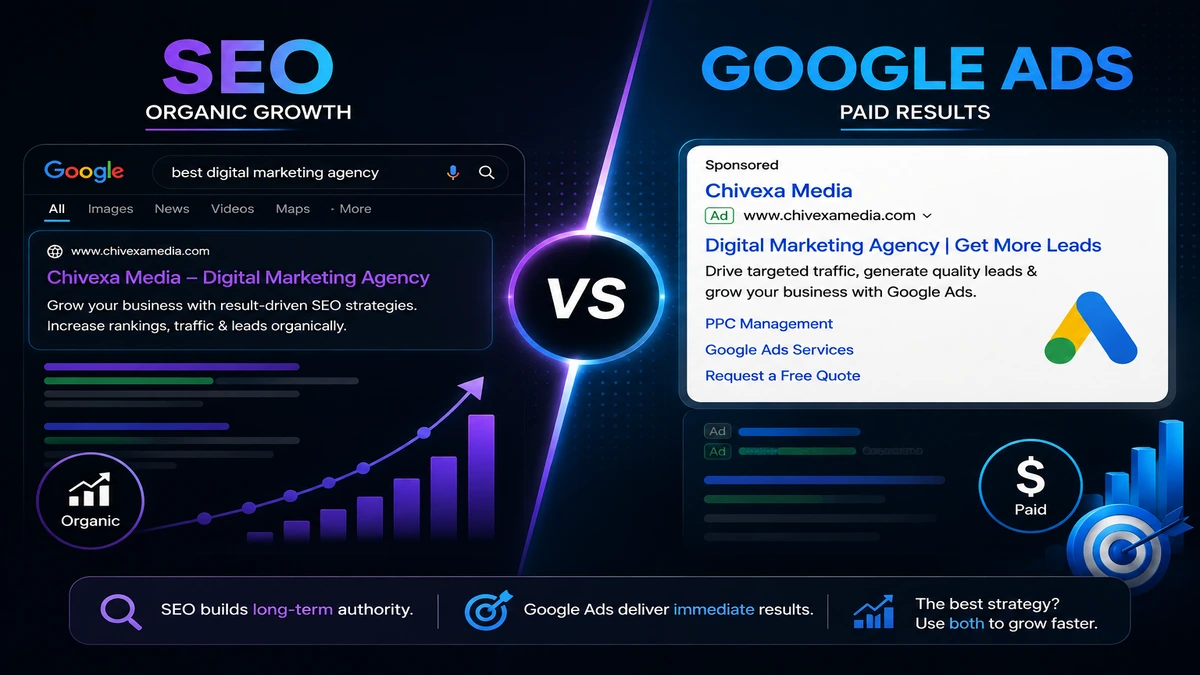
SEO vs Google Ads: Which Is Better for Business Growth in 2026?
SEO and Google Ads solve different problems. Here's how each one actually works, what it costs you in time versus budget, and a practical framework for deciding where to invest first.
Read Article
Digital Marketing Strategy
How to Choose the Right Digital Marketing Agency for Your Business
Most bad agency relationships aren't the result of bad work — they're the result of a mismatch that was visible before the contract was signed. Here's how to catch it early.
Read Article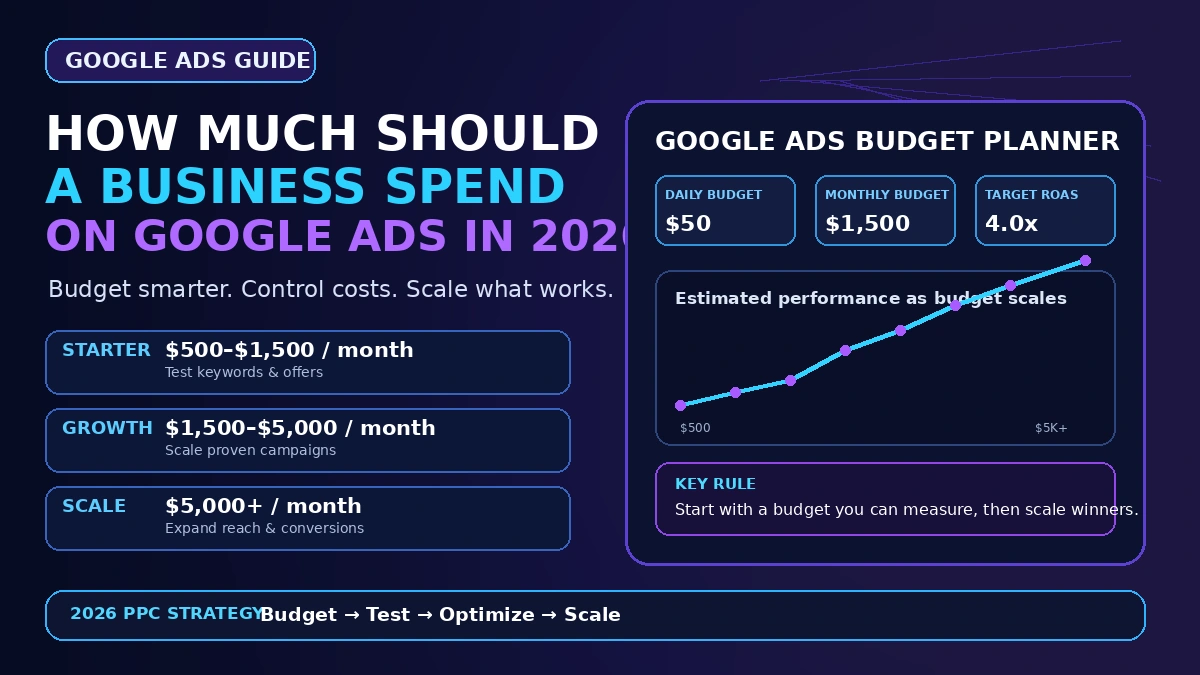
Paid Advertising
How Much Should a Business Spend on Google Ads in 2026?
Anyone who gives you a single dollar figure without knowing your industry, margins, and goals is guessing. Here's how to actually calculate a Google Ads budget that makes sense for your business.
Read Article