
Digital Marketing Strategy
Marketing Attribution Explained: How to Know Which Channels Drive Revenue
The channel that gets the last click before a sale isn't necessarily the channel that actually drove the decision. Attribution is how you find out which one really did.
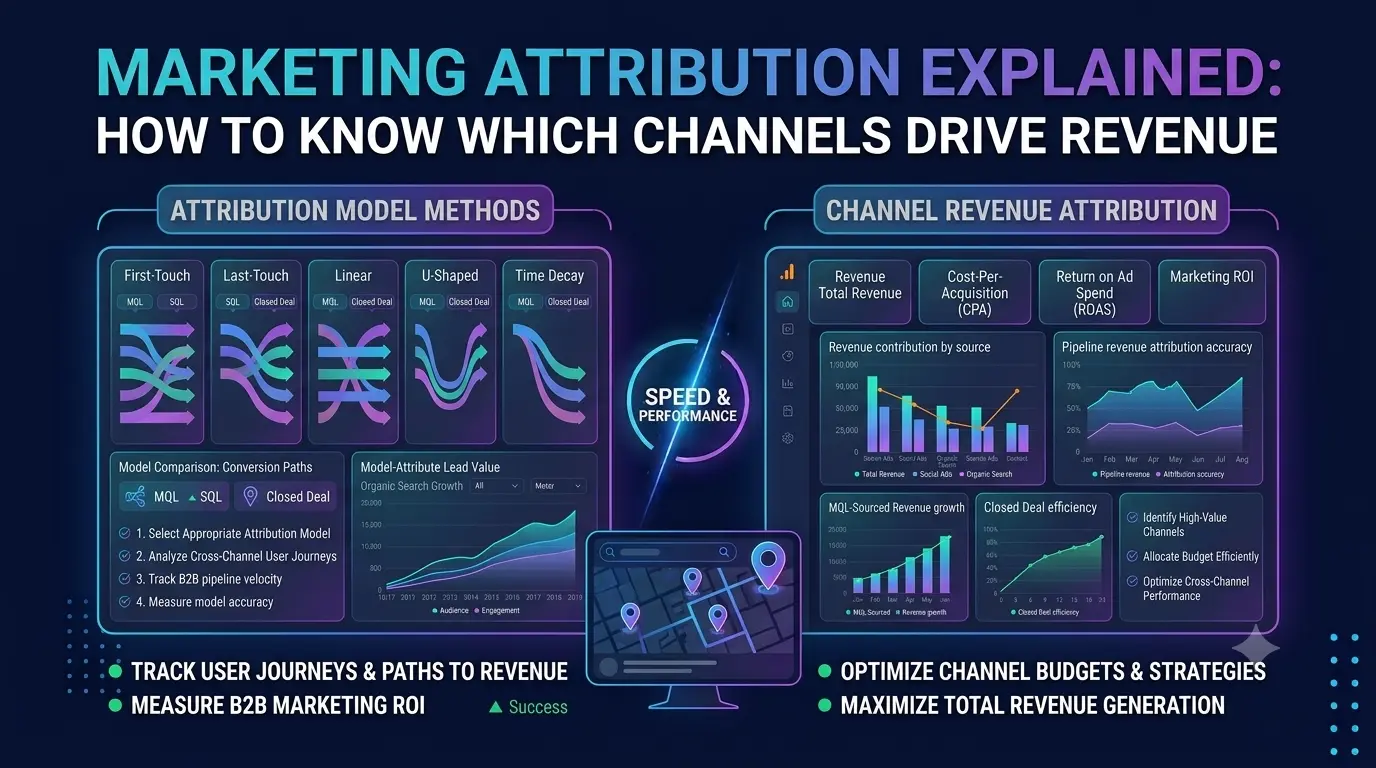
The short answer
Marketing attribution is the practice of assigning credit for a conversion to the marketing touchpoints that actually contributed to it — not just the single one that happened last. Most analytics tools default to last-click attribution, which gives 100% of the credit to whatever channel was clicked immediately before a sale, systematically hiding the contribution of everything that happened earlier in the journey. Understanding attribution properly is essential for measuring marketing ROI accurately, because the default model most businesses rely on without realizing it is often simply wrong.
Why last-click attribution is misleading
Consider a realistic path: someone discovers a business through a blog post found via organic search, sees a retargeting ad a few days later, and finally converts after searching the brand name directly. Last-click attribution credits only the branded search — the SEO content that actually started the journey, and the retargeting ad that kept the business top of mind, get no credit at all. This isn’t a rare edge case; it’s close to the normal path for most considered purchases, which makes last-click attribution’s blind spot a routine, not occasional, distortion.
Common attribution models
| Model | How it distributes credit |
|---|---|
| Last-click | 100% to the final touchpoint before conversion |
| First-click | 100% to the very first touchpoint in the journey |
| Linear | Equal credit across every touchpoint |
| Time-decay | More credit to touchpoints closer to the conversion, less to earlier ones |
| Position-based | Heavier credit to the first and last touchpoints, less to the middle |
No single model is universally “correct” — each represents a different assumption about how influence actually works across a journey, and the right choice depends on how your specific customers typically behave.
How to choose an approach that fits your business
- Short, simple conversion paths (one or two touchpoints, fast decisions) may not need sophisticated multi-touch modeling — last-click distortion matters less when there’s little to distort.
- Longer, multi-channel journeys (common in B2B and higher-consideration purchases) benefit significantly from multi-touch attribution, since single-touch models miss most of what actually influenced the decision.
- Limited tracking infrastructure may mean starting with a simpler model and improving data collection over time, rather than attempting sophisticated modeling on incomplete data.
Getting the fundamentals right first
Before choosing a specific attribution model, the underlying tracking needs to actually be reliable — consistent UTM tagging across campaigns, properly configured conversion tracking, and a clear definition of what counts as a conversion in the first place. Sophisticated attribution modeling built on inconsistent tracking data will still produce misleading results, regardless of which model is chosen.
Why attribution matters for budget decisions
Without reasonably accurate attribution, budget tends to flow toward whichever channel is easiest to measure — often paid search or direct/branded traffic — while channels that build awareness earlier in the journey, like content or SEO, appear to underperform simply because the measurement model can’t see their real contribution. This can lead to defunding channels that are actually working, based on an artifact of the measurement approach rather than genuine performance.
Common mistakes
- Relying on last-click attribution by default without realizing it’s systematically undercrediting earlier-funnel channels.
- Choosing a sophisticated attribution model before tracking fundamentals are reliable, producing precise-looking numbers built on incomplete data.
- Judging content and SEO channels by the same attribution standard as direct-response channels, when their actual contribution often happens earlier in a journey that simple models don’t capture well.
- Never revisiting the attribution model as the business’s channel mix and customer journey evolve over time.
The bottom line
Marketing attribution exists to correct a real, common distortion: crediting only the last touchpoint before a conversion while ignoring everything that actually built toward it. Get tracking fundamentals right first, choose an attribution model that reasonably matches how your customers actually behave, and revisit it periodically — the goal isn’t perfect precision, it’s a meaningfully more honest picture of which channels are actually driving results than the default last-click view most businesses unknowingly rely on.
Frequently asked questions
What's wrong with last-click attribution?
It gives 100% of the credit to whichever channel happened to be clicked immediately before a conversion, ignoring every other touchpoint that contributed earlier in the journey. A customer might discover a business through a blog post, later see a retargeting ad, and finally convert after a branded search — last-click attribution credits only the branded search, hiding the real contribution of the earlier touchpoints.
What is multi-touch attribution?
It's an approach that distributes credit for a conversion across multiple touchpoints in the customer's journey, rather than giving all the credit to a single interaction. Different multi-touch models (linear, time-decay, position-based) distribute that credit differently, but all of them aim to reflect a more complete picture than single-touch models.
Is multi-touch attribution worth setting up for a small business?
It depends on how many channels are actually in use and how complex the typical customer journey is. A business relying on one or two channels with short, simple conversion paths may not need sophisticated multi-touch modeling, while a business running several channels with longer consideration periods generally benefits significantly from it.
What tools are needed to track marketing attribution?
At a basic level, properly configured analytics with consistent UTM tagging and conversion tracking across channels. More sophisticated multi-touch attribution typically requires either a dedicated attribution platform or the multi-touch reporting features built into major analytics and advertising platforms.
Can attribution ever be perfectly accurate?
No — some portion of the customer journey (offline conversations, word of mouth, ad blockers affecting tracking) is genuinely difficult or impossible to capture perfectly. The goal of attribution isn't perfect precision, it's a meaningfully more accurate picture than the default of crediting a single touchpoint.
More insights
Digital Marketing Strategy
How to Measure Digital Marketing ROI: Metrics Every Business Should Track
Traffic, impressions, and likes are easy to report and rarely tell you whether marketing is actually working. Here's what to measure instead.
Read Article
SEO
SEO Reporting for Business Owners: Which Metrics Actually Matter?
A 40-tab SEO report full of metrics is easy to produce and hard to act on. Here's the short list that actually tells you whether SEO is working.
Read Article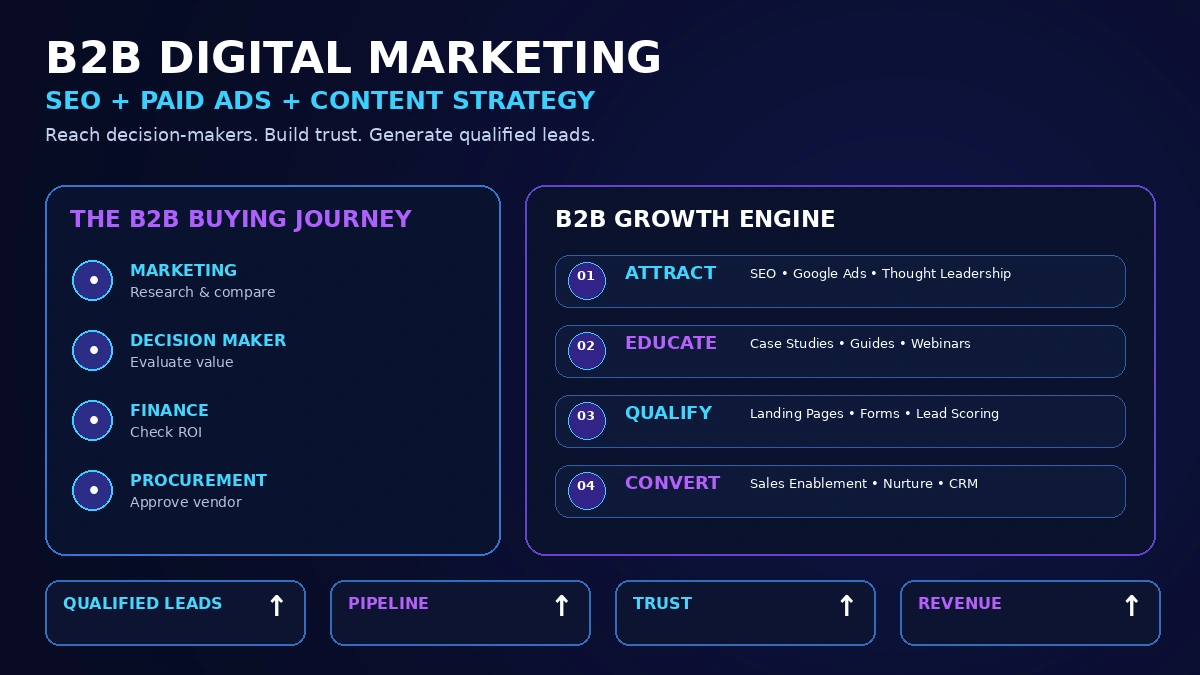
Digital Marketing Strategy
Digital Marketing for B2B Companies: SEO, Paid Ads and Content Strategy
By the time most B2B buyers talk to a salesperson, they've already done the majority of their research alone. That changes what SEO, ads, and content need to accomplish.
Read Article